My Child Can Recite Numbers, but Do They Understand Quantity? 8 Ways to Learn Counting Through Play
What's the difference between memorizing numbers and understanding quantity? 8 practical ways to count, match and compare objects during play, with an original study and its limits, and no tests or exaggerated promises.
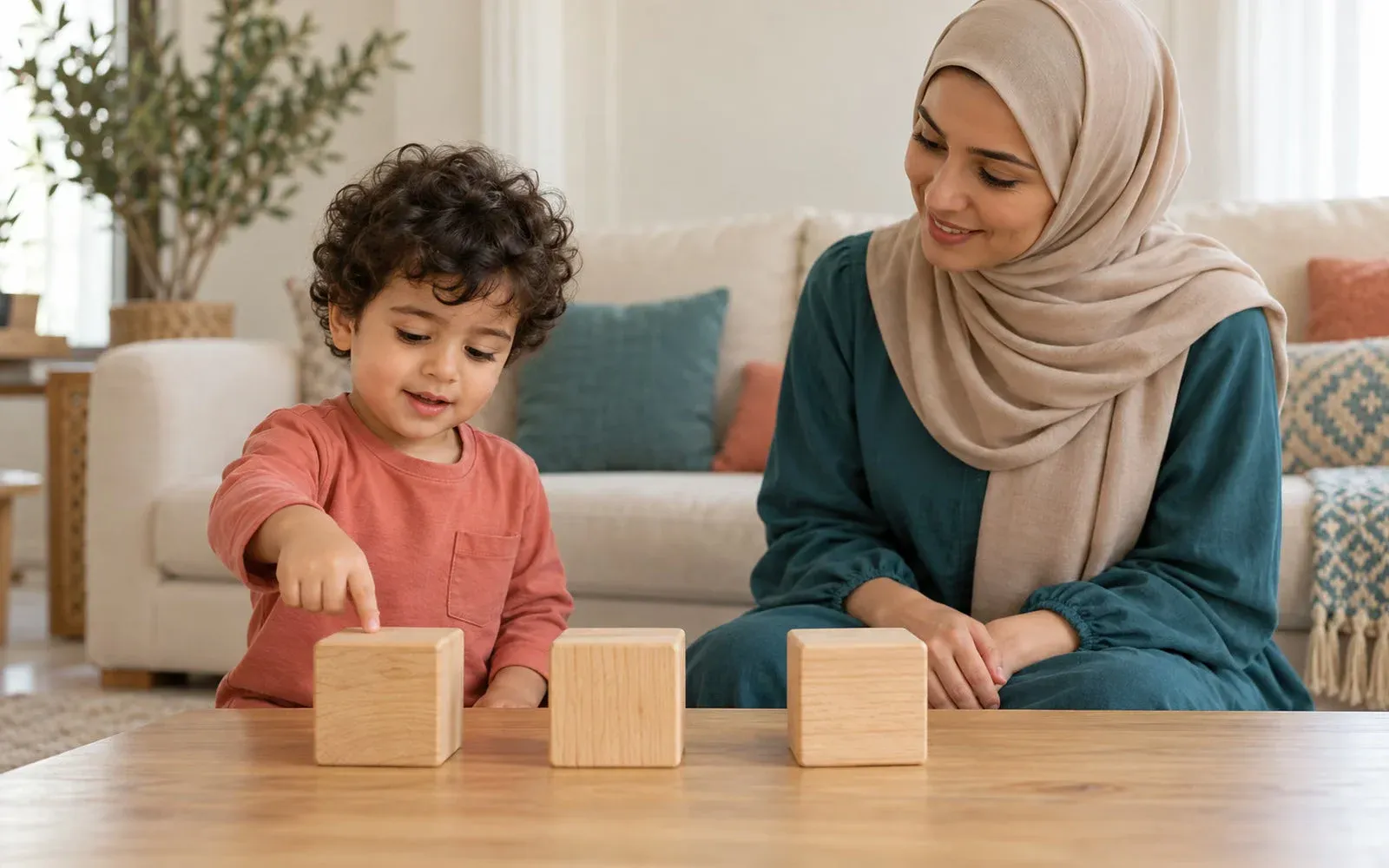
Your child counts to ten in a clear voice, but when you ask for two blocks, they hand you a whole fistful. Or they point to three pieces and say, “One, two, three, four,” even though they didn't add a piece. Should we go back to drilling numbers from the start? Not necessarily. Reciting number names, counting objects, and understanding how many are in a group are related, but they aren't the same task.
This guide helps parents open up simple opportunities to understand numbers during play and everyday life, especially in the preschool years. We don't need to test the child or buy a toy that promises to make them smarter. We'll use small groups, safe objects and clear phrases, along with an original study and supporting educational sources. The activities are examples to try, not a schedule that defines what every child should achieve at a certain age.
Three skills that look alike but are different
Reciting number names
A child may know a sequence like “one, two, three” the way they know a verse of a song. This is knowledge they can enjoy, but on its own it doesn't tell us how they connect the words to objects. We don't downplay their joy in memorizing, nor do we treat it as enough evidence that they understand every quantity they can name.
Counting each object once
When counting three pieces, each object needs to be matched with one number name. If the child touches the same block twice or skips a piece, the number they say differs from the quantity of the group. Slowing down the movement and lining up the pieces can be clearer than repeating a longer string of numbers.
Understanding that the last number describes the whole group
After “one, two, three,” we say: “Three blocks, all together three.” This is the idea of the total number, or quantity: the word “three” doesn't refer only to the last block, but to how many blocks we counted. There's no need to use the term with the child; it's enough to connect the word to the group in front of them.
NAEYC's material on number games explains the importance of connecting counting to the total number and offers ideas for counting and finger games. These are educational guidelines, not a home test. NAEYC number and counting games.
What does the original study say?
In 2010, Levine and colleagues followed a sample of 44 children and their caregivers. The researchers recorded home interactions during five visits between the ages of 14 and 30 months, then measured the children's understanding of number words as quantities at 46 months. The number talk children heard early on was associated with their later understanding of quantities, even after controlling for socioeconomic factors and other aspects of speech.
But the study is observational, not a randomized trial. The researchers point out that a child who is more interested in numbers may prompt their parents to talk about them more, or that other factors may play a role. So we don't treat the correlation as confirmed causation, we don't prescribe a daily “dose” of number words, and we don't promise better school achievement from a home activity. The sample came from English-speaking families in the Chicago area; we don't assume every detail of the findings applies directly to every child or every Arab context. The original study, and the full-text version.
Before you start: a small group and one goal
Choose large, safe objects that are easy to move: age-appropriate blocks, unbreakable cups, or clean socks. Don't use beads, coins, grains or small pieces with a child who might put them in their mouth. Being right next to them doesn't make an unsuitable object safe. For a refresher, read the toy safety guide for children under three.
Start with a small quantity the child can see and handle, such as two or three pieces; this is a suggestion to simplify the task, not an age standard. Keep the pieces similar in size and clearly visible on an uncluttered surface. Don't mix counting, color, shape, sorting and a speed contest right from the start.
Watch their interest before offering the activity. Maybe they want to build a tower, and a short number sentence can fit into their idea. And if they're tired or don't want to take part, there's no need to finish the activity. Distinguish between your invitation to play and an assignment that waits for a correct answer.
8 ways to connect numbers to quantities during play
The following steps are home examples prepared by Giggly, not a program the study tested in this order. Pick one, and adapt it to the child's way of communicating, their movement and their interests.
1. Count slowly while pointing to one object at a time
Place three large pieces in a clear row. Point to the first as you say “one,” then the second, “two,” then the third, “three.” The child can point or move the pieces to the other side. You don't need to move their hand for them; model the movement with your own hand, or let them watch if they want.
If their voice runs ahead of their hand, don't immediately say “wrong.” You can comment: “Our hand got to here, let's count them nice and slow.” Model it once more if they're still interested, then hand them the turn. And if moving objects is harder than pointing, adjust the approach; difficulty with movement shouldn't become an extra barrier to taking part.
A row isn't the only right way to arrange objects. We use it at first to make clear what has been counted and what hasn't been counted yet. If the child puts the pieces back into a building or a story, you can follow their play; the blocks don't all need to stay counting tools for the whole session.
2. End the count by naming the quantity, not with another question right away
After you count, say: “Three. We have three blocks.” Make it clear you're pointing to the whole group. Don't jump straight into “How many? And how many?” over and over. Sometimes a comment that links the number to the objects is more comfortable than asking the child to repeat the answer.
If they count again when you ask how many, let them finish if they want, then calmly name the total again. Don't treat recounting on its own as a mistake or a sign that they don't understand. One observation in one situation isn't enough to judge a whole skill.
A simple example while building: “We put one, two, three. The tower has three pieces.” Then you go back to the story or the building. This way, naming the number doesn't become a signal that the fun has stopped and a test has started. And there's no need to slip a number question into every tower they build.
3. Ask for a small quantity that has a purpose in the play
If you're building together, say: “I need two blocks for the door. Can you give me two?” Wait, and let them move the pieces. If they give you more, you can count what arrived: “I got three. For the door I need two.” Then offer to count together instead of turning the moment into a scolding.
The request may not be clear to them in words, or it may be hard for them to stop moving after taking a piece. So you can simplify your words, reduce the number of pieces on offer, or share in the choosing. Don't repeat the request more sternly and assume they aren't listening or are making mistakes on purpose.
Use the request within a story they want. If they're not interested in the door you're suggesting, they can build something else. Don't take away the pieces they chose in order to impose the task, and don't ask them to prove they know “two” in front of family members.
A child hands two large blocks to their mother during a game about quantity4. Put one object in each place
You can set one large toy cup for each large doll, or place one unbreakable cup on each placemat on the table. Start with a small number, in a spot with no hot dishes or sharp utensils. The adult might say, for example: “Here's a cup, and here's a cup. This spot is still empty.”
This is a chance to match an object to a place, and the child doesn't have to name the number first. They can notice a spot without a cup, or that there's an extra cup. When you're done, you can count the cups together and name the total if it suits the moment.
If they put two cups in one spot, describe what you see without judging: “Two here, and no cup here.” Then leave room for them to adjust it, or join in with them. The goal is to make the relationship clear, not to reach a perfect table setting or use play to assess their ability to help.
A child places one cup on each placemat on the table while their mother supervises5. Compare two small groups in a way they can see
Put two similar pieces in one group and three in another, without spreading one group far apart or making its pieces bigger. You can say: “This one has two pieces, and this one has three.” And if they want to know which has more, line the pieces up in facing pairs so the object left without a partner shows.
Don't mix up the number of pieces with their size at first; one huge block and three small ones add a different question about quantity. Likewise, we don't use the length of a row alone to judge the number. Choose a clear arrangement, then let the child count or match if they want.
If they choose the smaller group because it's their favorite color, don't treat it as a wrong answer about which has more unless that's the question they understood. You can clarify what you mean once: “I'm talking about the number of pieces, not the color.” And if they don't want to, keep playing without pushing.
A mother and child compare two groups of two blocks and three blocks6. Use fingers when the child is comfortable with it
You can show two fingers when saying “two,” or slowly count fingers that are visible. They don't have to copy the same hand shape; they might point to your fingers or use large objects instead. If moving their fingers is hard or bothersome, choose another way to represent the number without pressure.
NAEYC encourages using fingers and gestures as tools for seeing and showing number ideas. We use this as educational guidance, not a claim that one method suits everyone. Guidance on showing mathematical ideas. There's no need to hide fingers so the child seems more advanced.
Start with a clear display they can see, and avoid quick flashes if they make them guess anxiously. And if they want to show you their fingers, take the role of listener. They can choose the number and how to show it, and each round doesn't have to be harder than the last.
7. Accept recounting, then notice what stayed the same
After counting a small group, you can rearrange the pieces without adding or removing anything. Say: “They're still the same pieces, we just moved them around.” If they want to count again, let them. Don't make the idea a trap to prove they were swayed by the length of the row or forgot the number.
This is an optional extension for an interested child, not a step they must master before continuing to play. It may be better to keep the same arrangement several times. If they seem confused, go back to a simpler group and visible counting, instead of a long explanation about the number staying the same.
For a child who likes repeating the idea, there's no need to add bigger numbers right away. You can use the same blocks in another activity. See the guide to repetitive play and keeping it fresh for more ideas; repetition isn't a standing invitation to increase the difficulty.
8. Mention numbers in natural conversation, without counting everything
You might say while getting dressed: “Two socks, one for each foot,” or while putting books away: “We put back two books.” Pick a clear opportunity, then let the conversation take its course. There's no need to turn breakfast, walks and bath time into a series of number questions.
When the child starts counting something on their own, follow what they mean. And if they mention a number within a make-believe story, distinguish between play and a counting task: maybe they want ten imaginary cars, not a description of what's in front of them. We don't correct every number we hear without understanding the context.
And the study's findings don't mean parents need to monitor how many words they say each day. A clear sentence tied to something present is easier to apply than an exhausting goal of talking more. And if no chance comes up on a busy day, there's no missed session to make up.
A complete example: three pieces and a road for the car
This is an original dialogue to try, not a script from a research experiment. The child wants a road made of large blocks for a large, age-appropriate car:
- Mom: “Should we put these next to each other?”
- The child agrees and places the pieces.
- Mom points slowly: “One, two, three. We have three pieces for the road.”
- The child pushes the car along the road.
- Mom follows the child's story instead of interrupting with a new question.
Play may continue without any more counting. Another time, the child may ask for an extra piece, and you can count the new group if they want. We don't add the piece just to turn the moment into an addition problem, and we don't ask for the next number before letting the car drive through.
How do we know the activity is a good fit without testing?
Watch how comfortably they take part: Can they see the pieces and reach them? Did they understand what you're asking? Do they want to keep going? If they're moving lots of objects and losing track of which ones were counted, make the group smaller or make their places clearer. And if they need more time, don't make speed the measure of success.
Don't look for a single response that proves understanding forever. A child may succeed in a familiar situation and then get confused with other objects or different wording. These are observations that help simplify play, not scores for comparing them with a sibling or a child in a video.
When frustration hits, offer simple help or a break. You can say: “Shall we count together?” or “Let's finish later.” For more examples, read encouraging effort during play without pressure. We don't make finishing the activity a condition for moving on to something else.
Three adjustments that make the idea clearer
If instructions get mixed up, simplify your words, not your view of the child
Instead of “Bring two of the blue blocks and put one by the bear and one by the car,” choose a single request: “Give me two.” You can add where to put them later. When the words are long, it's hard to tell whether the confusion is about the number or about remembering the steps. And we don't test understanding in a language or phrasing the child doesn't use easily.
You can explain the idea in the dialect you usually speak with them. And if they hear number names in another language or in formal Standard Arabic in a book, clarify the meaning by connecting it to the objects in front of them, without switching languages several times just to find a correct answer. These are suggestions to make the moment easier, not a scientific comparison between dialects and languages.
If the pieces move around a lot, choose two clear areas
You can put the pieces that haven't been counted on one side, and move each piece to the other side after counting it. You don't need a special tray or printed lines. Leave enough space between objects to see them, and avoid a slippery surface or one cluttered with other toys. If the child wants to move the pieces freely, end the counting task and join in their idea.
If they want the adult's role, switch roles
They might tell you: “Give me two blocks.” Take the request seriously and hand over the quantity, and you can count it out loud. Don't keep making mistakes on purpose to force the child to correct you. Taking turns is a way to keep the interaction shared, not a trick to test them again. And they may enjoy being the one in charge more than answering another question.
What about number cards and writing?
A child may love the shape of a written numeral, but recognizing it isn't the same as knowing how many objects there are. If you add a card, you can pair it with a small group in front of them. There's no need to introduce the written symbol at first, or to ask the child to draw it before they can join a conversation about numbers.
Choose a clear, consistent way to read the written numerals you use, and don't let differences in how numerals look in different books become a reason for constant correction. The goal of these ideas remains understanding a quantity that's right there, not handwriting practice or finishing a worksheet. And you can practice this without a screen or printouts at all.
Frequently asked questions
Does reciting numbers to ten mean my child understands ten objects?
Not necessarily. Reciting and understanding quantity are two different tasks. You can enjoy the memorizing and add simple opportunities to count a few objects, without asking for a large quantity just because they know its name.
How many pieces should I start with?
Try a small, clear quantity, such as two or three pieces, and adjust based on how they take part. This is a suggestion for simplicity, not a required number or a developmental standard for each age.
My child counts a piece twice. What should I do?
Slow down your modeling, space the pieces apart, or move each piece after counting it if moving is comfortable for them. Avoid scolding, and don't repeat the activity until it becomes tiring.
Do they have to say the number out loud?
There's no need to require a spoken response in play. They can point, hand over a group, or use their own way of communicating. The adult can name the quantity without asking them to repeat the word.
Is using fingers a habit I should stop?
There's no need to stop it in these activities. It's a visual way to represent numbers if it's comfortable. Large pieces or other gestures can be used when needed.
Do we need a specialized educational toy?
No. You can start with safe, suitable household objects. A toy's price or educational label doesn't guarantee learning; what matters most is a clear idea, the way you interact, and safe materials.
Should I give a reward for every correct answer?
These ideas don't need a reward system. You can notice what the child did and enjoy playing with them, without turning every number into a test waiting for a prize.
When should I worry if they don't understand quantity?
We don't offer diagnostic age cutoffs here. Discuss ongoing concerns with their teacher or pediatrician, especially if they involve other areas of communication and learning. One counting session isn't enough to diagnose a problem.
The takeaway: tie numbers to something the child can see
Next time you play, choose a small, safe group, count each object once, then name the whole quantity. After that, let the child carry on with their idea. You can come back to asking for a quantity or matching objects another time, but you don't need to do all eight steps together. The aim is comfortable opportunities that make sense, not a race to memorize bigger numbers.
Scientific and educational sources
- Levine and colleagues, 2010: What counts in the development of young children's number knowledge?, Developmental Psychology, 46(5), 1309–1319. DOI: 10.1037/a0019671. The methods, results and discussion of the limits on causation were reviewed in the full text.
- NAEYC: Play Games, Learn Math! Explore Numbers and Counting with Dot Card and Finger Games, supporting educational source, October 2017.
- NAEYC: Helping Your Child See and Show Mathematical Ideas, guidance for families on representing ideas with fingers, gestures and objects.