The Best Toys for Developing Fine Motor Skills in Children Ages 2 to 3
Which toys give a child a real chance to use their hands and fingers? Discover sorting, fitting, stacking, puzzle and lacing toys suitable for ages 2 to 3, and how to choose a safe level of challenge for each child.
The Best Toys for Developing Fine Motor Skills in Children Ages 2 to 3
Between ages 2 and 3, children start using their hands in more precise ways: holding a container steady with one hand and opening its lid with the other, trying out buttons and switches, building with blocks, and, close to age 3, perhaps starting to thread large pieces onto a string. These simple everyday movements are part of fine motor skills, in which a child uses the muscles of the hands and fingers to control objects.
But the right toy doesn’t need dozens of lights and sounds, or an exaggerated promise that it “boosts intelligence.” The best choice is a safe activity that suits your child’s current abilities and gives them repeated chances to grasp, twist, pull, sort, fit pieces together and try again.
In this guide, we’ll introduce you to the types of toys that let children practice these skills between ages 2 and 3, and how to choose the right level of challenge without offering a toy that’s too easy or frustrating.
Important note: The ages given here are general guidelines, not a test of your child’s development. Children differ in the pace at which they gain skills, and you should always follow the age grading and warnings printed on the toy’s package. If you have concerns about your child’s development, the right source is your pediatrician or a specialist.
What Are Fine Motor Skills?
Fine motor skills are the small, coordinated movements that help a child grasp, move and control objects using their hands and fingers. Later on, children use them in many everyday activities, such as eating with a spoon or fork, turning the pages of a book, opening some lids, drawing and getting dressed.
And the hand doesn’t work alone during play: the child looks at the piece, judges where it goes, then moves it toward the opening or the right spot. That’s why sorting toys, puzzles and stacking toys are often described as also letting children practice hand-eye coordination.
What Can We Roughly Expect Between Ages 2 and 3?
According to the developmental milestones from the Centers for Disease Control and Prevention (CDC), many children at age 2 try to use switches and buttons on toys, and hold something in one hand while using the other hand to work with it. By age 3, many children can string large items, use a fork and draw a circle after being shown how.
These milestones help us understand what kind of movement suits each stage, but they don’t mean every child must do an activity on the same day or in the same way. What matters most when choosing a toy is observing your own child:
-
Can they hold the pieces safely?
-
Do they understand the idea after watching briefly?
-
Do they try more than once without getting constantly upset?
-
Does the toy have a harder level they can move on to later?
1. Sorting and Shape-Posting Toys
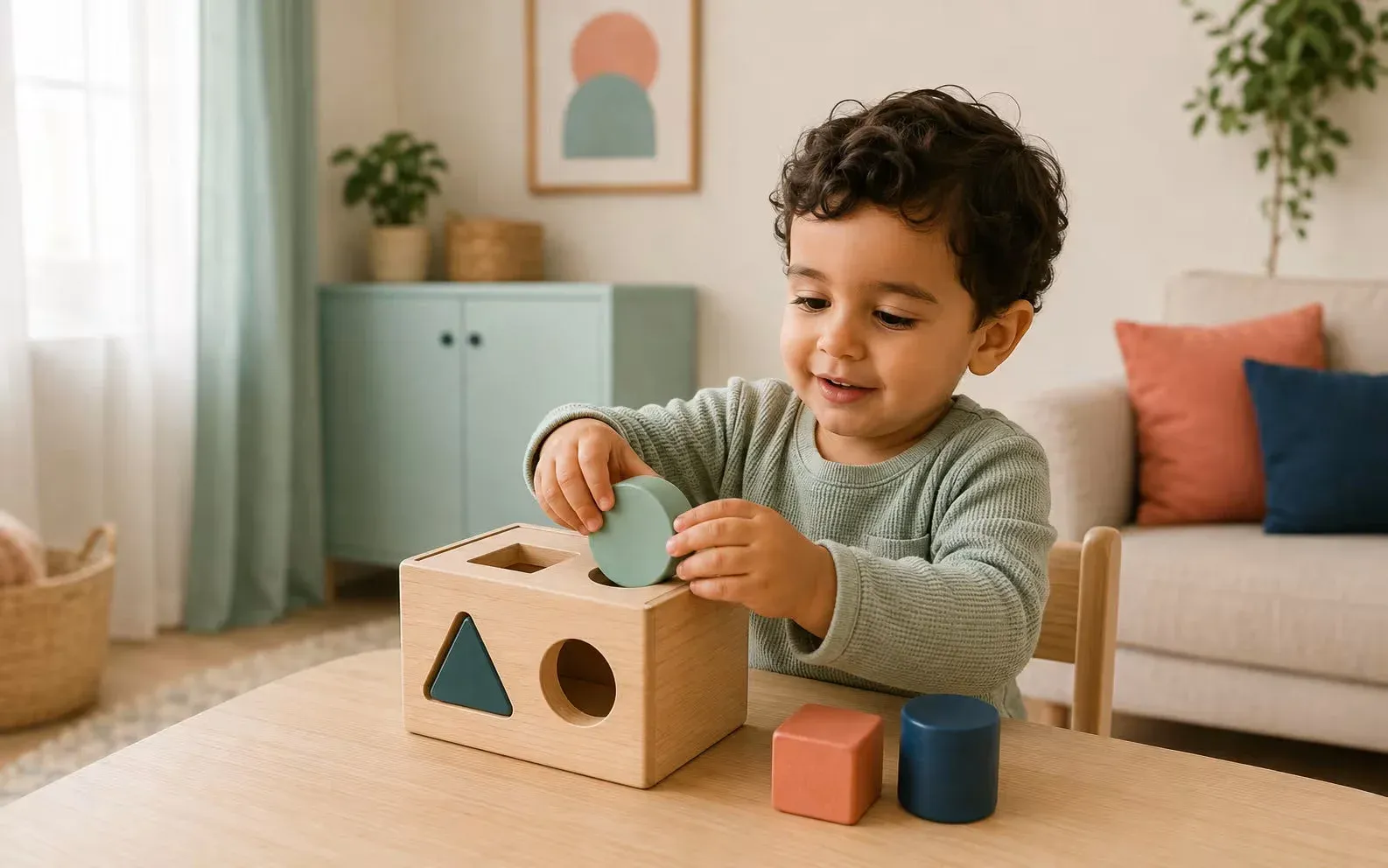
With shape sorters, the child looks for the right opening, then turns the piece and changes its angle until it goes in. This process lets them practice gripping the piece, rotating the wrist, using both hands together, and coordinating what they see with what their hand does.
What should we look for?
-
Large pieces that can’t fit entirely in your child’s mouth.
-
Clear shapes that are truly different, not similar openings that confuse them for no reason.
-
Smooth edges and a stable box that doesn’t tip over easily.
-
A limited number of shapes at first, then gradually more choices.
Start with just two or three pieces instead of offering the whole set. Once your child understands the idea, add the rest of the pieces. The goal isn’t to finish the toy as fast as possible, but to give them room to observe and try.
2. Stacking and Building Toys
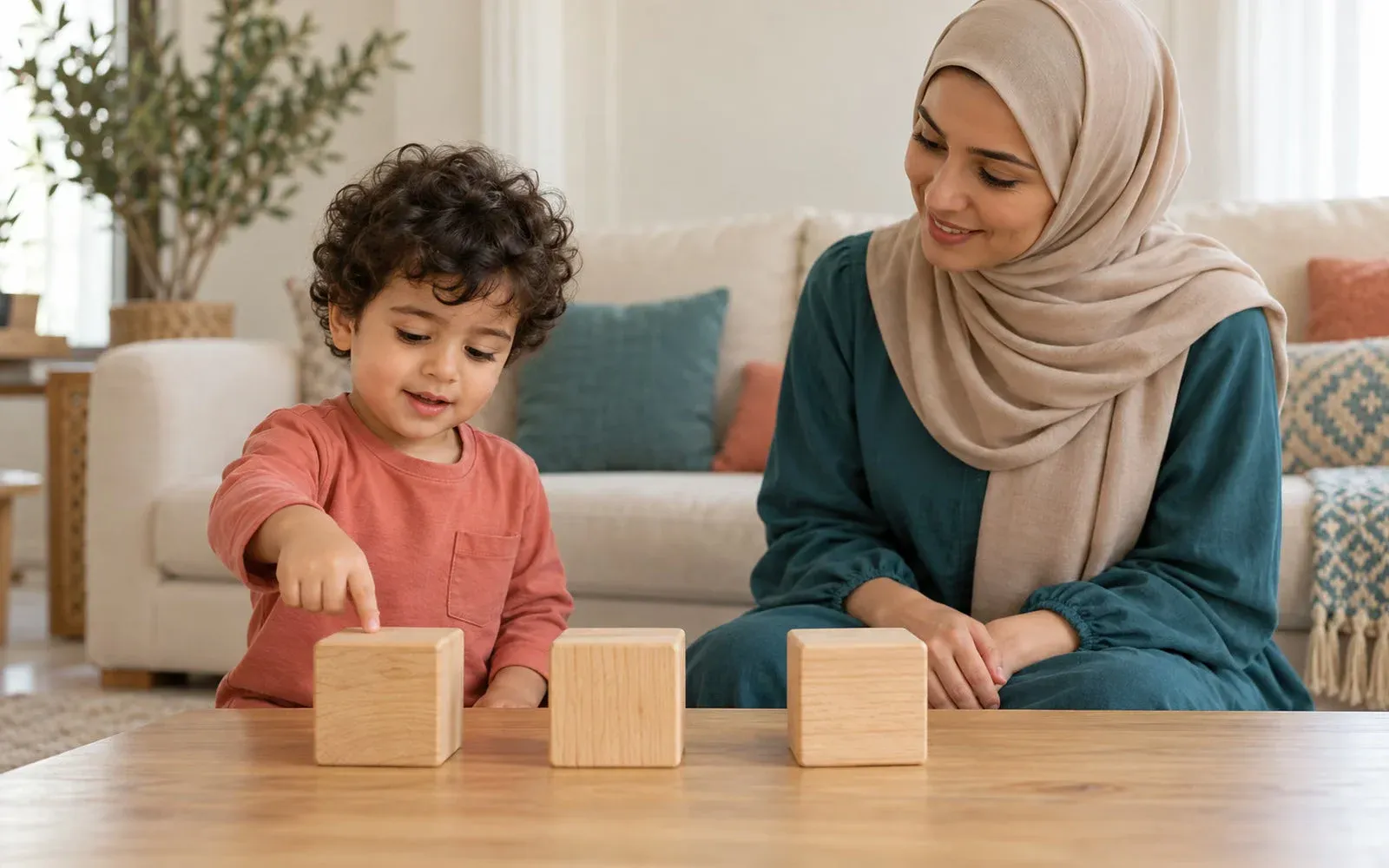
Large blocks, stacking rings and pieces that build on top of each other give a child the chance to grasp, place and balance. And when the tower falls, the child learns through experience that a piece’s position and size affect the result.
You can change the way of playing from day to day:
-
Building a short tower of two or three pieces.
-
Arranging the pieces from largest to smallest.
-
Copying a simple model built by a parent.
-
Sorting the pieces by color before building.
-
Building a road or a wall instead of a tower.
A toy that can be used in more than one way usually stays suitable longer than a toy with only one outcome.
3. Simple Puzzles with Large Pieces
A puzzle that suits this stage isn’t measured only by its number of pieces. The piece itself should be easy to grasp, the picture or the spot where it fits should be clear, and the level of challenge should be close to your child’s ability.
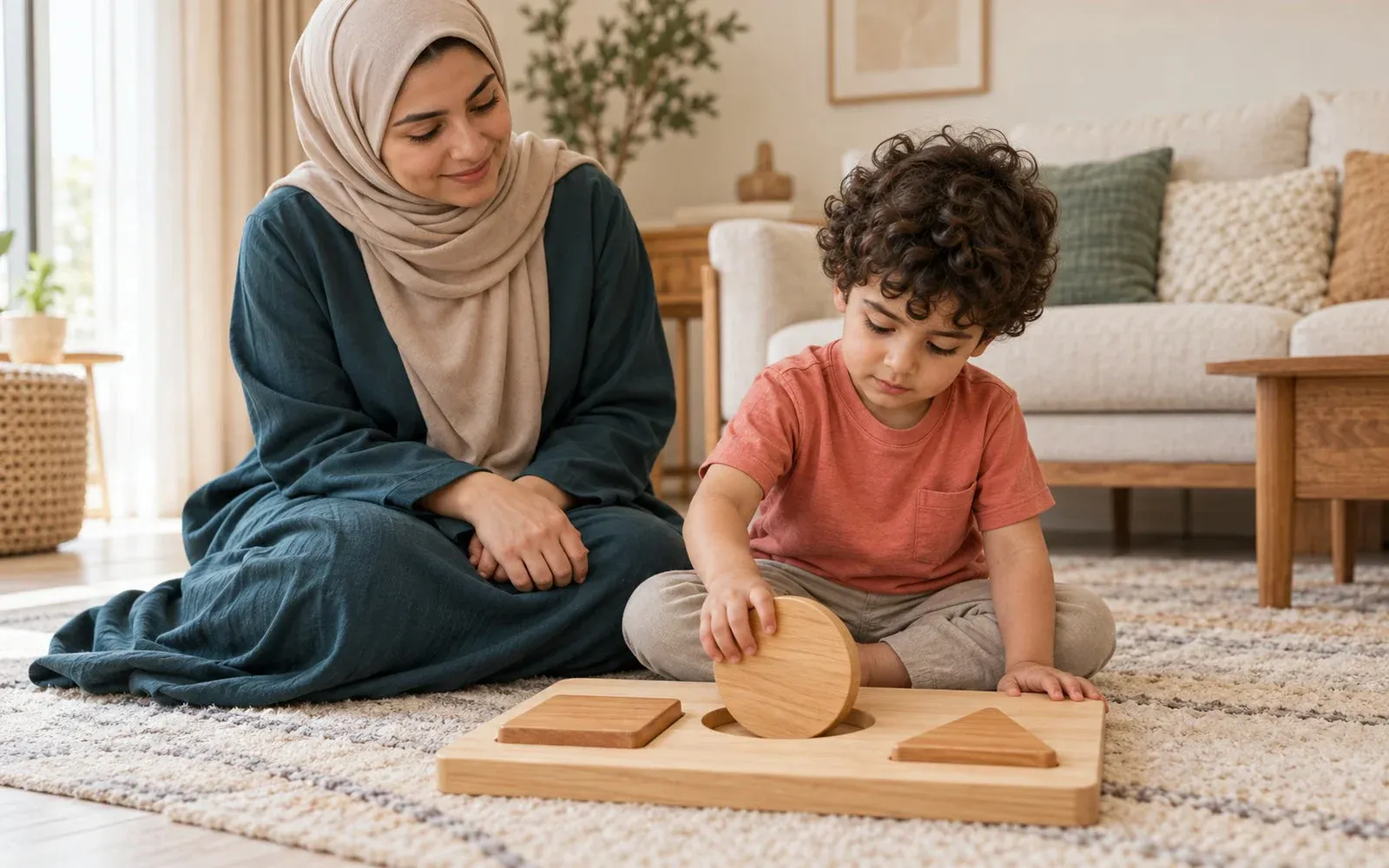
At first, you can choose a wooden puzzle with a few large pieces or with pieces that have knobs. Knobs help a child use their fingertips, while putting a piece in its place requires turning it and lining it up with the space.
If your child abandons the toy right away, the number of pieces or how similar they are may be more than is suitable. And if they finish it on the first try without concentrating, you can move on to a slightly harder shape instead of jumping to a complicated puzzle.
4. Lacing and Threading Toys
Close to age 3, a child may start threading large pieces or large beads designed for children onto a thick string. The activity requires holding the string steady with one hand, guiding the piece with the other, then pulling it through once it’s across.
This type of toy needs to be chosen carefully:
-
The pieces should be large and clearly graded for the right age.
-
It’s best if the tip of the string is stiff and easy to insert.
-
The string should be the safe length specified by the manufacturer.
-
The activity needs direct supervision, especially when your child is close to the minimum age.
Don’t use small craft beads in place of the pieces from an approved children’s toy; a similar-looking activity doesn’t mean an equal level of safety.
5. Activity Boards with Buttons, Locks and Moving Parts
Toys with large, age-appropriate buttons, switches, wheels and latches give a child a variety of hand movements in one toy. They might push a button with one finger, turn a dial, open a little door or slide a piece along a track.
Choose a board that doesn’t rely only on having lots of elements. A small number of clear, sturdy parts is better than a board crowded with small or easily detached elements. And check the parts regularly to make sure they stay firmly attached.
6. Drawing, Stickers and Children’s Dough
Not every hand activity needs a complicated toy. Large washable crayons, large stickers and non-toxic dough made for your child’s age allow for varied practice such as pressing, pulling, peeling, squeezing and drawing.
You can offer a large sheet of paper and just two or three crayons, or make big balls of dough and invite your child to press and flatten them. There’s no need to ask your child to draw a perfect shape; scribbling, moving and exploring are the right activity at the start.
Always check that the materials are labeled non-toxic and suitable for your child’s age, with adult supervision and without letting them go in the mouth.
How Do We Introduce a Toy Without Doing It for the Child?
It’s natural to want to help your child when an attempt doesn’t work, but finishing the activity for them takes away the most important part: the experience of trying.
Try this sequence:
1. Slowly demonstrate one movement, like turning one piece and putting it in.
2. Hand the piece back to your child and give them enough time to try.
3. Use a short hint: “Try turning it” or “Where’s the same shape?”
4. If they need help, move the piece closer to the right spot instead of fitting it in completely.
5. Praise the effort and persistence, not just speed and the result.
And if your child refuses the toy, there’s no need to turn it into a test. You can put it away for a few days, then offer it in a different way or with fewer pieces.
How Do We Know the Level of Challenge Is Right?
The right toy isn’t one your child finishes instantly, or one where they need full help at every step. Look for the middle ground: your child understands the goal, succeeds at part of it, and needs several tries or a simple hint to complete it.
The toy is too easy when:
-
They finish it quickly, again and again, without concentrating.
-
They only come back to it to do the same thing the same way.
-
It offers no other way to sort, build or fit pieces together.
The toy is too hard when:
-
They can’t grasp or control the pieces at all.
-
They don’t understand what to do even after a simple demonstration.
-
They need the adult to do most of the steps.
-
They walk away upset every time.
Before buying a new toy, try simplifying the current one: reduce the number of pieces, steady the toy’s base, or start with a single step. Sometimes changing how you present it is enough.
A Quick Safety Checklist Before Play
Building skills never comes before safety. Check the toy when you buy it and regularly after use:
-
Follow the age printed on the package and the accompanying warnings.
-
For children under 3, avoid toys that contain small parts or parts that could come off and become small.
-
Make sure handles, wheels and buttons are secure, with no cracks or sharp edges.
-
Choose paints and materials described as non-toxic and made for children.
-
Keep button batteries, and batteries in general, inside a compartment your child can’t open.
-
Avoid small or detachable magnets. If a toy contains a magnet, it must be tightly sealed inside the toy, with strict adherence to the age grading and a check every time it’s used.
-
Supervise play when the toy includes a string or moving parts, or when your child is just starting to learn the activity.
-
Keep older children’s toys away from the younger child’s play space.
And having an adult present doesn’t make a toy that isn’t right for your child’s age safe; supervision is important, but it doesn’t replace choosing a toy designed for that age group in the first place.
Does Your Child Need a New Toy for Every Skill?
No. Children can practice hand movements using safe, clean household items, such as large plastic containers with easy lids, or suitable spoons and bowls, under adult supervision. World Health Organization guidance explains that play materials don’t always have to be bought; what matters is that they’re safe and suitable, and that the caregiver joins the child in play and communication.
The advantage a well-designed toy offers is bringing the activity together in a sturdy, clear, graduated form that suits the child. So don’t just ask, “How many functions does this toy have?” Ask, “Will my child be able to use it in more than one way, and safely?”
How Do We Choose Among These Toys?
If your child has just turned 2, start with large pieces, simple puzzles, and stacking and sorting toys with a limited number of choices. As their ability to use both hands together grows, you can add buttons, latches and more precise fitting. And close to age 3, you can try lacing activities with large, age-appropriate pieces, under supervision.
There’s no single “best” toy for all children. The best is whatever suits your child’s current skills, offers a small challenge they can handle, allows more than one way to play, and meets safety requirements.
You can also read our guide: How to Choose the Right Educational Toy for Your Child’s Age: From 6 Months to 3 Years, or browse the educational toys at Giggly to choose a toy by age and way of playing.
Frequently Asked Questions
What’s the best toy for strengthening hand and finger movement for a 2-year-old?
There’s no single toy that suits everyone. Stacking toys, shape sorters with large pieces, and simple puzzles with knobs are usually a good starting point, as long as they’re graded for your child’s age and don’t contain small parts.
How many pieces should a puzzle have for a 2-year-old?
More important than a fixed number are the size and clarity of the pieces and your child’s current ability. Start with a few large pieces, then increase the challenge once your child can complete it with a little help or none at all.
Are lacing toys suitable for a 2-year-old?
Some lacing toys are graded for specific ages, but threading pieces onto a string shows up in many children close to age 3. Always follow the manufacturer’s age grading, and use large pieces and a safe string with direct supervision.
Are wooden toys better for fine motor skills?
The material alone doesn’t determine a toy’s value. A wooden or plastic toy can be a good fit if its design is sturdy, its parts are a safe size, and its level of challenge is appropriate. Focus on manufacturing quality, the way of playing and the age grading more than on the material description alone.
When should I move on to a harder toy?
When your child completes the activity easily again and again, you can increase the challenge gradually: add pieces, introduce sorting by a new attribute, or build a slightly harder model. There’s no need to jump from a simple activity to a complicated toy all at once.