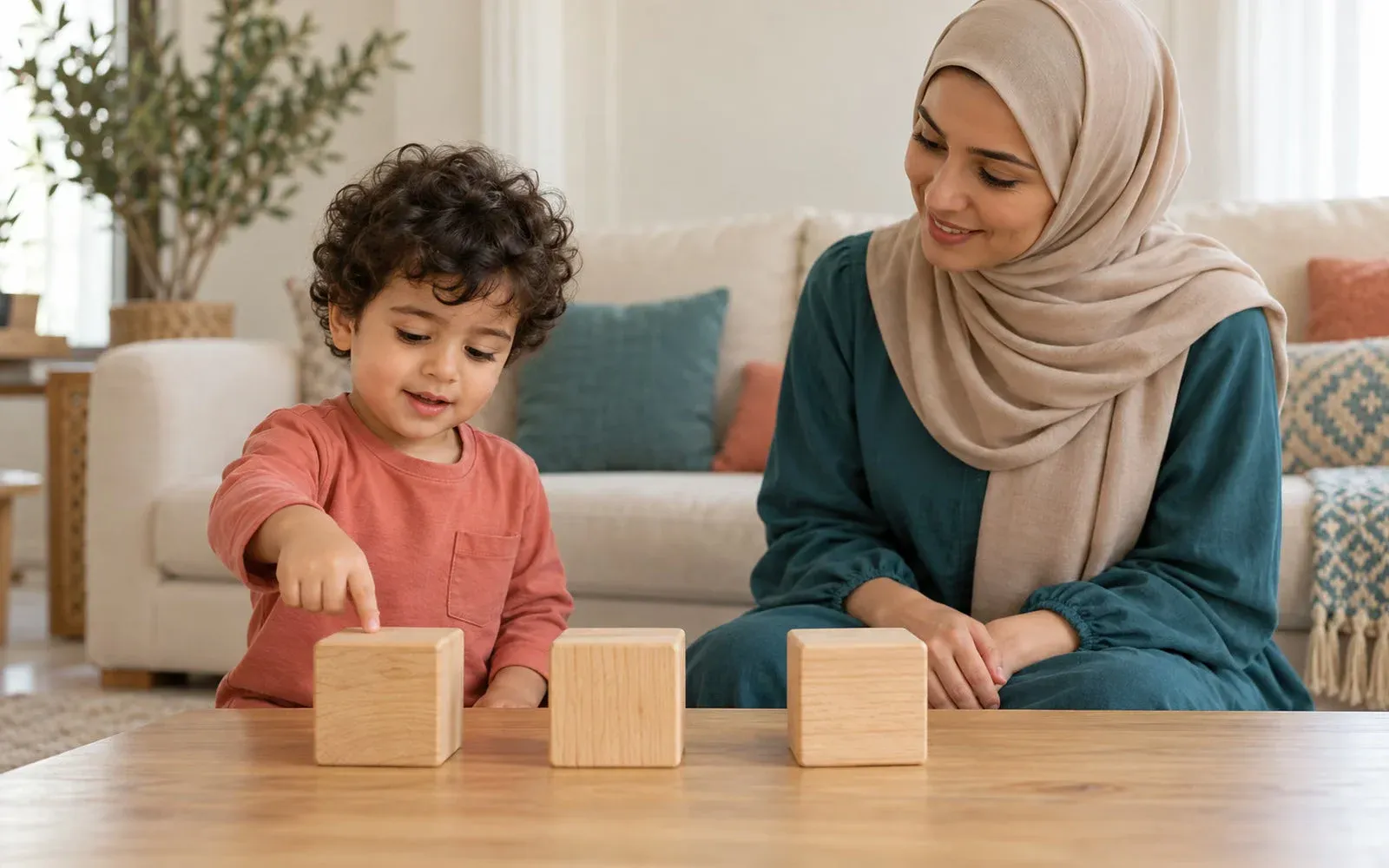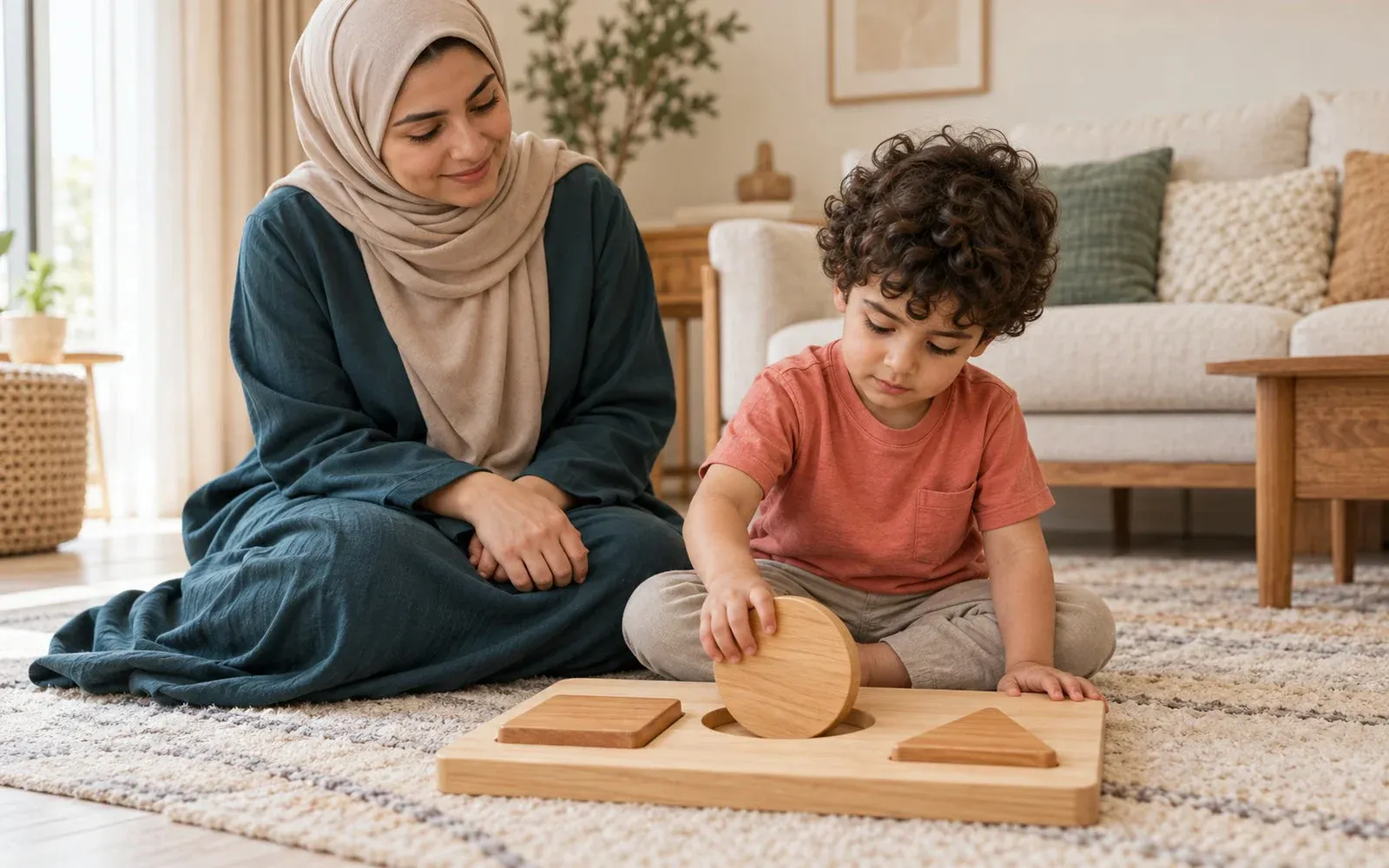
What Are Montessori Toys? A Practical Guide to Choosing Them Beyond the Marketing Label
Not every wooden toy is a Montessori toy, and the word “Montessori” on the box isn’t proof enough. Learn the principles that set Montessori-inspired toys and activities apart, and how to safely choose what suits your child’s age.
What Are Montessori Toys? A Practical Guide to Choosing Them Beyond the Marketing Label
All it takes is an online search for children’s toys to find the word “Montessori” on puzzles, lock boards, sorting toys, blocks, and sometimes even on toys crowded with lights and sounds. So the harder question is no longer “Where can we find Montessori toys?” but: Does everything carrying this name actually align with the method’s principles?
The short answer: no.
Montessori isn’t a muted color palette, a wooden material or a pretty look that photographs well. It’s a complete educational approach developed more than a century ago by the Italian physician and educator Maria Montessori. It rests on a prepared environment, hands-on materials, the child choosing a purposeful activity, and a progression that suits their stage, with a calm adult role that helps without doing the task for the child.
When we talk about “Montessori toys” at home, we’re usually not talking about the original classroom materials themselves, but about toys or activities inspired by Montessori principles. That’s a more accurate description, and it helps parents judge a toy by how it’s used, not by the name printed on it.
In this guide you’ll find practical criteria for choosing, the difference between Montessori, educational and wooden toys, suitable examples from 6 months to 3 years, and how to introduce a toy at home without turning play into a lesson or a test.
Important note: The ages and examples in this guide are general guidelines. Always follow the age grading and warnings set by the manufacturer, and take into account your child’s current abilities and how they actually use the toy.
What Do We Mean by Montessori Toys?
In an authentic Montessori environment, there are learning materials carefully designed to serve a specific purpose. They’re presented simply, and then the child uses them hands-on, independently. The American Montessori Society explains that early childhood materials usually focus on one skill at a time, and that many of them let the child notice and correct a mistake through the material itself, rather than waiting for an adult to say the answer is wrong.
As for infants and toddlers, the Society explains that Maria Montessori didn’t personally develop a set of materials for these ages the way she did for later stages, but that materials were designed afterward in the spirit of her method. So it isn’t accurate to consider any modern toy carrying the name an “original Montessori material.”
At home, we can use a practical description:
A Montessori-inspired toy is one that suits the child’s stage, offers them a hands-on, purposeful activity they can take part in with their own hands, and helps them try independently, without effects or interventions that do the task for them.
This toy might be a simple object permanence box, a puzzle with just a few pieces, stacking rings, a matching activity or a small, child-sized tool for everyday life. But the name alone isn’t enough; what matters is the design and the way it’s presented.
7 Signs That Help You Choose a Montessori-Inspired Toy
1. It suits your child’s current ability, not just the age on the label
The age grading on the package is the starting point, especially when it comes to safety, but on its own it doesn’t tell us whether the level of challenge is right for a particular child. Watch what your child can do right now: Can they hold the piece? Do they understand the movement after a simple demonstration? Can they succeed at part of the activity after a few tries?
The right toy gives a child a small, manageable challenge. If the adult needs to do most of the steps, the activity is probably premature. And if the child completes it on autopilot every time, it’s time to raise the challenge a little.
2. It has a clear purpose instead of a pile of functions
A hallmark of many Montessori materials is isolating a single skill or concept. An object permanence box focuses on dropping the piece in and noticing where it reappears, a simple puzzle focuses on matching a piece to its spot, and stacking rings invite comparing sizes and putting them in order.
This doesn’t mean every toy must be used one way forever, but it does mean the child can understand what the toy offers without facing a crowded board with ten buttons, lights and sounds that aren’t tied to any clear goal.
Ask before buying: What is the main movement or idea the child will carry out on their own? If we can’t find a clear answer, the product description may be bigger than its practical value.
3. The child is the one doing the action
In hands-on play, the child holds, turns, opens, closes, arranges, pours, transfers and compares. A toy that runs by itself after you press a button may be entertaining, but it gives the child a smaller role in the activity.
This doesn’t mean every electronic toy is bad, or that the home should be free of sound and movement. The point is simply that a toy closer to Montessori principles makes the child’s action what drives the experience, not automated effects.
4. It lets the child notice the result
With a material that has “control of error,” the child can see or feel that something isn’t complete: the puzzle piece won’t sit in the wrong spot, the large cylinder won’t fit in the small hole, and the order of the rings doesn’t look graduated.
The toy doesn’t need to make a sound saying “right” or “wrong.” Sometimes it’s better for the result itself to give quiet feedback and then leave room to try again. This reduces the child’s reliance on an adult’s judgment at every step.
5. It supports a degree of independence
Independence doesn’t mean leaving your child alone or expecting them to master the activity right away. It means the size of the toy or tool and the way it’s set out are suitable, so the child can carry it, get started and put its pieces back, with limited help when needed.
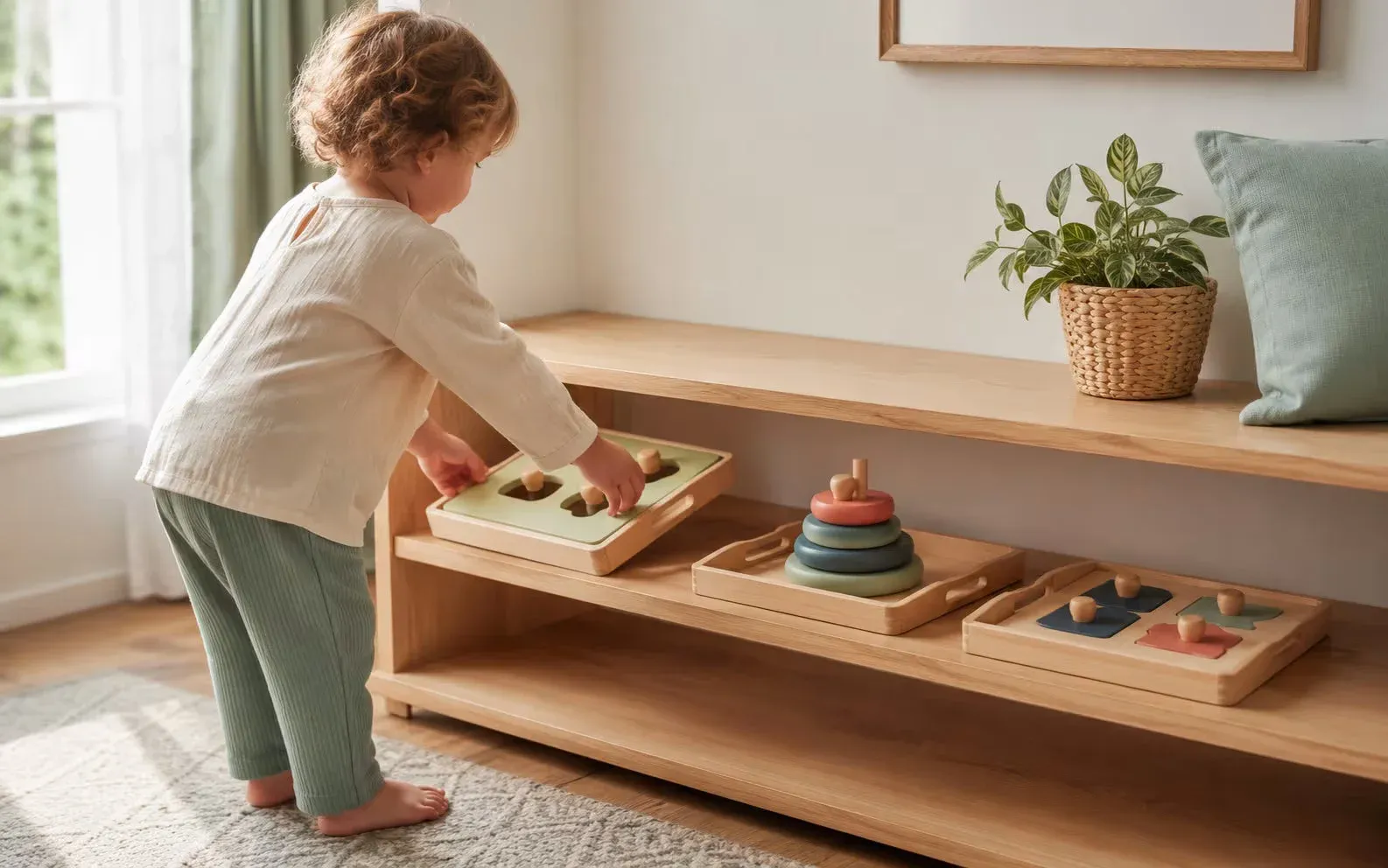
You can place a small number of toys on a low shelf, arrange each toy in its own basket or tray, and keep all its pieces together. When the environment is clear and uncluttered, it’s easier for a child to choose, get started and put the toy back in its place.
6. Its design is simple and sturdy, but it doesn’t have to be wooden
In marketing, the image of Montessori is tied to natural wood and earthy colors, but the Association Montessori Internationale explains that materials were historically made of wood because it was the available, customary material, and because it’s durable and can last for years when cared for.
So wood is a beautiful, sturdy choice, but it isn’t proof that a toy is Montessori. A well-designed plastic toy that is sturdy, non-toxic and age-appropriate may be closer to the principles than a cluttered or poorly made wooden one.
And the colors don’t have to be muted. A material can be clearly colorful if the color serves matching or distinguishing and doesn’t overpower the activity.
7. It’s safe for your child’s age and actual use
The words “natural” or “wooden” don’t automatically make a toy safe. Check the size of the pieces, how secure the knobs and magnets are, the smoothness of the edges, the quality of the paint, the length of any strings, and how the battery compartment closes, if there is one.
The American Academy of Pediatrics recommends reading the age label and warnings and choosing pieces that are larger than a young child’s mouth, and it advises avoiding toys that contain button batteries or high-powered magnets. The U.S. Consumer Product Safety Commission notes that toys whose pieces pose a choking hazard for children under 3 must carry an appropriate age grading and warning.
Supervision is important, but it doesn’t turn a toy that isn’t right for your child’s age into one that is.
Is Every Wooden Toy a Montessori Toy?
No. The material tells us what the toy is made of, not how the child will play with it.
A wooden toy might be:
-
Suitable and designed around a clear activity.
-
Beautiful but too advanced for your child’s age.
-
Crowded with several unrelated functions.
-
Made with small pieces or poorly secured parts.
-
An excellent open-ended toy, but not a specific Montessori material.
On the other hand, a toy made of sturdy plastic can be useful, clear, safe and right for your child’s stage. So don’t base your buying decision only on “wood or plastic.” Look at the purpose, the age, how your child takes part, the manufacturing quality, and safety.
What’s the Difference Between a Montessori Toy, an Educational Toy and an Open-Ended Toy?
These descriptions overlap, but they don’t mean the same thing:
Description What does it mean in practice? Example Montessori-inspired A hands-on, clear activity suited to the child’s stage that encourages independence and may let the child notice mistakes An object permanence box or a simple puzzle Educational toy A broad term for any toy that offers a chance to learn or practice a concept or skill A color- or number-matching game Open-ended toy Doesn’t impose a single outcome and can be used in many ways Building blocks or modeling pieces Wooden toy A description of the material only; it doesn’t define the method or the benefit Could be a puzzle, a car or blocksOpen-ended play is important and valuable, but it isn’t a synonym for Montessori. Some Montessori materials have a specific purpose and sequence, while blocks, for example, offer dozens of possibilities. We don’t have to pick one side; a child’s space can include both purpose-driven activities and open-ended toys.
Examples of Montessori-Inspired Toys and Activities by Age
From about 6 to 12 months
At this stage, we look for simple activities that suit grasping, transferring and safe sensory exploration, such as:
-
Large, easy-to-grasp, age-appropriate rings or pieces.
-
A simple toy that shows how an action leads to a result, with no small parts.
-
Large, safe containers for putting a large piece in and taking it out.
-
Balls or sensory items clearly designed for your child’s age.
Expect your child to put things in their mouth, so safety, piece size and material quality matter more than the number of skills listed on the package.
From about 12 to 24 months
As your child’s ability to grasp, walk and use their hands grows, you can try:
-
Object permanence boxes with one large piece or a few pieces.
-
Stacking rings or nesting cups.
-
A very simple puzzle with large pieces and knobs.
-
Clear, well-secured opening-and-closing toys.
-
Child-sized everyday tools for moving large, safe objects or wiping a small table with an adult’s help.
Offer one activity or a small number of pieces, rather than putting out every option at once.
From about 2 to 3 years
Activities can become more precise and graduated, such as:
-
Sorting shapes or colors with a suitable number of choices.
-
Puzzles with large pieces but slightly more detail.
-
Matching pictures or figures of familiar things from real life.
-
Boards with large, securely fastened locks or latches.
-
Threading large, age-appropriate pieces onto a safe string, under supervision.
-
Simple everyday-life activities: transferring, pouring a small amount, arranging or cleaning with tools suited to your child’s size.
These are examples, not a list of required milestones. If you’d like to dig deeper into toys that let children practice using their hands, read our guide to toys for developing fine motor skills in children ages 2 to 3.
How Can We Introduce a Toy at Home in a Way That’s Closer to Montessori Principles?
How a toy is presented can matter more than how it looks. A simple toy can become confusing if we put all its pieces in among ten other toys, while an activity becomes clearer when the space is tidy and the steps are few.
Try this approach:
-
Choose a calm time: Don’t introduce the activity when your child is tired, hungry or surrounded by a lot of noise.
-
Put the whole toy on a tray or in a basket: so its beginning and end are clear.
-
Demonstrate the main movement slowly: without a long explanation or quizzing your child with questions.
-
Step back a little: Give your child time to hold it, try it and repeat.
-
Help as little as possible: Move the piece closer or show one step again, instead of finishing the task.
-
Let repetition happen: Your child may choose the same activity many times; repetition is part of learning and not necessarily boredom.
-
Return the toy to a consistent spot: so your child knows where to find it and where to put it back.
The Association Montessori Internationale explains that an adult’s presentation offers the minimum needed to get the child engaged, and the goal is then for the activity to shift into self-directed discovery. This doesn’t mean total silence or refusing to play together; it means not controlling every movement or turning the activity into a string of commands.
Should We Put Out All the Toys at the Same Time?
It isn’t necessary. A crowded shelf can make choosing harder and scatter pieces among the toys. Start with a small, varied selection, such as:
-
A posting (drop-in) activity or a puzzle.
-
A stacking or building toy.
-
A simple everyday-life activity.
-
One or two books within your child’s reach.
Watch how the toys are used before rotating them. If your child has mastered an activity and no longer goes back to it, you can increase the challenge or rotate it out for a while. And if they ignore a new toy, that doesn’t mean it’s bad; maybe its time hasn’t come yet, or how to use it isn’t clear yet.
6 Common Mistakes When Buying Montessori Toys
1. Buying the name instead of examining the toy
It isn’t enough for the seller to write “Montessori.” Read the details on age, piece size, materials, how it’s played with, and the warnings.
2. Treating wood as proof of quality
Wood can crack, the paint can be poor or the parts can be loose. Check the craftsmanship just as you would with any other material.
3. Choosing a toy beyond your child’s ability so it lasts longer
Buying a challenge that comes too early doesn’t guarantee more value; it may end up with the adult doing the playing. It’s better to choose a toy that suits the current stage and can be made gradually more difficult.
4. Being drawn to a “10-in-1” toy with no clear purpose
The number of functions isn’t a measure of quality. Sometimes a single clear, sturdy activity gets used more than a crowded board.
5. Correcting your child on every attempt
If we rush to tell them the right spot, the activity turns into waiting for our directions. Give them time to notice the piece and the result and to try again.
6. Turning play into a test
There’s no need to keep asking, “What color is this? How many pieces? Where’s the triangle?” You can name things naturally during play, but your child also needs space to explore without constant evaluation.
A Quick Checklist Before Buying a Toy Described as Montessori
Ask yourself these questions:
-
Does it suit the age on the package and my child’s current ability?
-
What is the main activity my child will do with their hands?
-
Can they understand the goal after a short demonstration?
-
Does the result give them a chance to notice a mistake or adjust?
-
Can they use the toy with growing independence?
-
Is the design clear and not crowded with effects that don’t serve the activity?
-
Are the pieces large, safe and secure, and are the materials suitable for children?
-
Am I buying the toy because of how it’s used, or just because of the word “Montessori”?
If the answers are clear, you’re making a better decision than relying on color, material and a marketing label.
How Do We Handle the “Montessori” Label at Giggly?
At Giggly, we prefer to describe what your child can do with the toy, the recommended age, the materials, the pieces and the warnings, rather than settling for a big word like “Montessori” or an exaggerated promise like “boosts intelligence.”
Some toys may be inspired by Montessori principles because they’re simple, hands-on and support independent trying, but that doesn’t make every wooden toy an original Montessori material. An accurate description helps parents choose what truly suits their child.
You can start with our guide to choosing the right educational toy for your child’s age, then browse the educational toys at Giggly and compare the age, the way of playing and the warnings for each product.
The Bottom Line
The best way to choose a Montessori-inspired toy is to ignore the label for a moment and look at the experience itself: Is the child the one doing the action? Is the activity clear and suited to their stage? Can they try independently? And is the toy safe and sturdy?
Wooden isn’t automatically better, the most expensive isn’t the most educational, and the toy with the most functions isn’t the best fit. Sometimes a simple piece, a calm moment and room to try are all a child needs.
Frequently Asked Questions
What are the best Montessori toys for children?
There’s no single toy that’s best for every child. Look for an activity that suits your child’s age and current ability, has a clear purpose, and has them holding, trying and repeating on their own. Examples include object permanence boxes, stacking rings, simple puzzles, and age-appropriate matching and sorting activities.
Do Montessori toys have to be made of wood?
No. Wood is sturdy and beautiful, but it isn’t an educational requirement that makes a toy Montessori. What matters most is a clear activity, age-appropriateness, the child’s real participation, and the quality of manufacturing and safety.
Are battery-operated toys not Montessori?
Many Montessori-inspired activities don’t need batteries, because the child’s own movement drives the activity. But the presence of a battery alone isn’t enough to judge; look at the child’s role: Are they exploring and using their hands, or pressing a button and then letting the toy run the whole show?
What’s the difference between Montessori toys and educational toys?
“Educational toys” is a broad description that covers a lot of toys. A Montessori-inspired toy, on the other hand, tends toward a hands-on, clear activity that suits the child’s stage, encourages independence, and may let the child notice the result and correct their attempt on their own.
Can we apply Montessori at home without buying lots of toys?
Yes. Arranging the environment, providing tools suited to your child’s size, involving them in simple, safe everyday tasks, and presenting a small number of activities clearly matter more than buying a big set with the Montessori name on it.
When should I swap or rotate toys?
There’s no fixed schedule. Watch your child: if they’ve mastered an activity and no longer go back to it, you can increase the challenge or put it away for a while. And if they keep coming back to it and trying again, there’s no need to take it away just because a few days have passed.
Does open-ended play like blocks count as Montessori?
Open-ended play is excellent, but it isn’t a synonym for Montessori. Some Montessori materials have a specific purpose and sequence, while blocks allow for endless outcomes. You can combine both types in a balanced play space.
Trusted Sources Used in Preparing This Article
-
What Is Montessori Education? — American Montessori Society (AMS)
-
Early Childhood Materials: One Skill at a Time and Control of Error — AMS
-
Children Working with Materials and the Role of the Brief Presentation — AMI
-
The Prepared Environment and Independence in the First 3 Years — AMI
-
Choosing Simple Toys and the Role of Parent Interaction — American Academy of Pediatrics