Pretend Play in Children: When Does It Start? 9 Simple Ways to Support It at Home
When does an empty cup turn into an imaginary drink, and a block into a phone or food for a doll? Learn what pretend play means and its approximate stages, and try 9 simple ways to support it with things you already have at home.
Pretend Play in Children: When Does It Start? 9 Simple Ways to Support It at Home
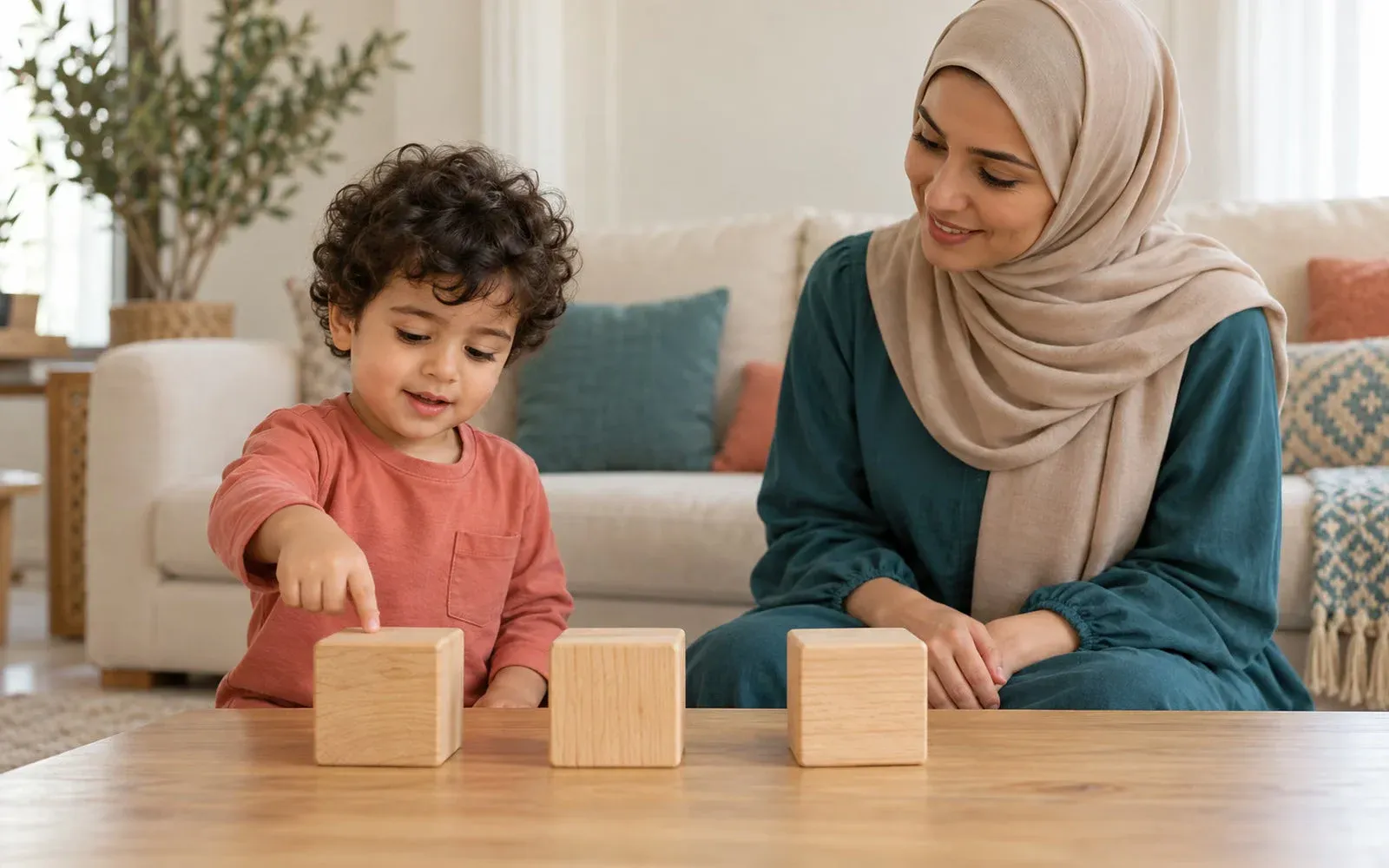
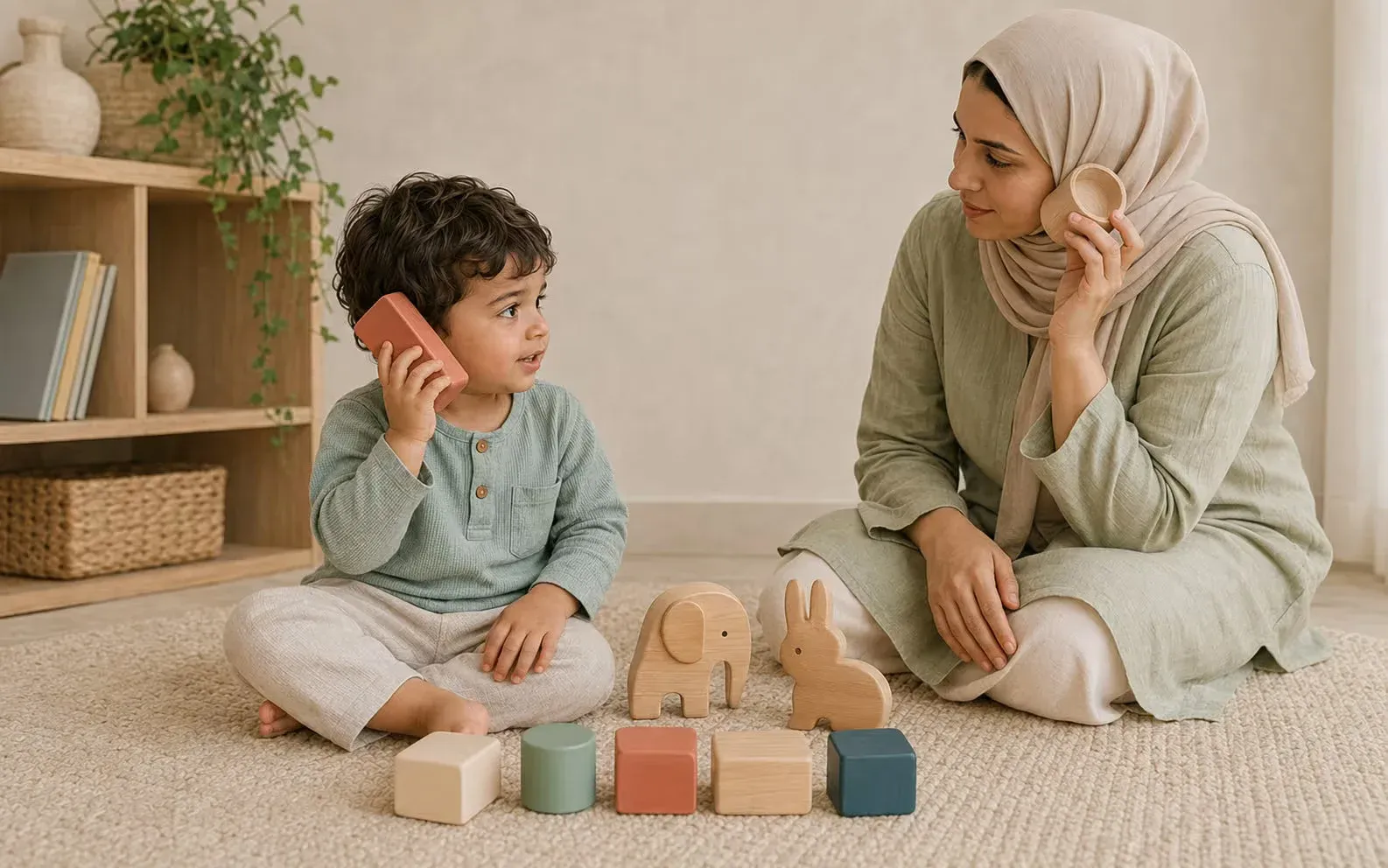
Your child picks up an empty cup and drinks from it, then offers you a sip that isn’t there. They tuck a doll under a piece of cloth and ask everyone to be quiet because she’s “sleeping.” And after a while, a block might become a phone, a plate a steering wheel, and a row of blocks a long train.
These little moments are the beginnings of pretend play in children: a child acting as if an object, a role, or an event that isn’t really in front of them is actually happening. This kind of play doesn’t require lots of costumes or a huge play kitchen. Sometimes the idea starts with a safe spoon, an empty bowl, and an everyday scene the child has seen at home.
But when does pretend play start? Does a child have to invent a whole story before we count what they’re doing as pretending? And how can we join in without taking over the story?
In this guide, we’ll explain the difference between functional play and pretend play, and the approximate stages we might notice from the end of the second year onward, then offer 9 practical ways to support it with simple toys and materials.
Important note: The ages and examples in this guide are approximate and are not an at-home developmental test. Children differ in when they develop skills and how they show them, and a child’s development can’t be judged, nor any condition diagnosed, from the presence or absence of pretend play alone. If you have broader concerns about your child’s play, speech, or communication, or you notice they’ve lost a skill they used to have, talk to your pediatrician and ask for a developmental screening if needed.
What Is Pretend Play?
Pretend play, also called imaginative or symbolic play, is when a child acts as if something else is happening. They might imitate a real event, give an object a new meaning, or take on someone else’s role.
Examples include:
-
Pretending to drink from an empty cup.
-
Feeding a doll or a toy animal.
-
Turning a block into a piece of cake or a phone.
-
Pushing a small box as if it were a car.
-
Pretending to be a doctor examining their doll.
-
Lining up blocks into a road, then driving a car along it.
-
Playing the shopkeeper while someone else plays the customer.
“Pretend” doesn’t mean a child has to see things that aren’t there or tell a long story. At first, it may be a single, very short action, like bringing an empty spoon up to a doll’s mouth.
What’s the Difference Between Functional Play and Pretend Play?
Both matter, and they often overlap in the same play session.
Functional play
The child uses an object the way it’s meant to be used: pushing a car along the floor, stacking blocks, putting a ring on a post, or drinking from their real cup.
Pretend play
The child adds a meaning that isn’t literally there: making the car go to sleep, turning a block into a cup, or pretending a plate is a steering wheel.
A child may start by using objects for their usual purpose and then gradually move on to pretending. Among the cognitive milestones for 30 months, the CDC gives the example of using an object to pretend, such as offering a block to a doll as if it were food. This is an illustrative example, not a required activity that every child must do in the same way.
When Does Pretend Play Start in Children?
There’s no single moment when play suddenly changes. We usually see a progression from imitating and using objects for real, to pretending with an action, then using one object to stand for another, and then building roles and longer stories.
Approximate stage What we might see in play A simple example Around 15–18 months Imitating how objects are used and simple everyday actions Putting a cup to their mouth or imitating wiping the table Around 18–24 months Early pretending tied to a familiar routine Drinking from an empty cup or feeding a doll Around 2 to 2½ years Repeating a short scene, possibly applying it to a doll or another person Feeding the doll and then putting it to bed Around 30 months and beyond May use one thing to represent something else Making a block into food or a phone From about 3 years and up Roles and stories, simpler at first, then more connected over time Doctor and patient, a store, a kitchen, a car tripThese aren’t strict cutoffs. An early form may appear and then disappear for days, or a child may repeat one scene for a long time before adding a new step. Pretending may also show up while playing with you before it clearly appears when they play alone.
The CDC explains that developmental milestones describe what most children, meaning 75% or more, can do by a certain age, but they don’t replace developmental screening. So we use the table to understand the progression, not to compare a child against an exact deadline.
What Does Research Say About the Benefits of Pretend Play?
Play in general is linked to opportunities for developing language, problem-solving, social interaction, and emotional regulation. In pretend play specifically, a child practices the idea that one thing can represent another, a symbolic idea similar to using words to represent people, objects, and ideas.
Pretending also gives a child room to replay scenes from life: feeding a doll, visiting the doctor, packing a bag, or comforting a toy animal. And during shared play, natural opportunities arise to use words, actions, and simple sequences like: “We cooked, we served the food, then the doll ate.”
But it’s important not to turn these connections into promises. A large review published in Psychological Bulletin examined claims about the effects of pretend play on different areas of development and concluded that much of the evidence is correlational or open to multiple interpretations. In other words: pretend play is a rich experience that suits childhood, but it isn’t accurate to say that a particular pretend-play toy will make a child smarter or treat a language delay.
It’s more accurate to say that this kind of play provides opportunities to use symbols, words, roles, and sequences, within a responsive relationship with an adult and a safe environment.
1. Watch for the Idea Before You Join the Play
Before making a suggestion, wait a little. Is the child bringing the cup to their mouth? Covering the doll? Lining up the blocks like a train?
Jumping in quickly with “Let’s open a restaurant” can interrupt an idea that was just taking shape. You can start with a short comment describing what you see:
-
“Teddy’s drinking.”
-
“You put the blocks in a long line.”
-
“The car went into the house.”
If the child looks at you or hands you something, join the story they started. And if they carry on alone, stay close without adding a new task.
2. Show One Action, Then Wait
If the child hasn’t started pretending yet, we don’t need a long explanation. Pick up an empty cup and pretend to take one sip, or cover the doll with a piece of cloth, and then stop.
After showing the action:
-
Hand the object back to the child.
-
Wait instead of repeating instructions.
-
Accept any safe use they choose.
-
Model it again on another day if they don’t imitate it now.
They don’t need to copy the action right away. They might watch it today and use it later in their own way.
3. Start with a Routine Your Child Knows
Everyday events are easier than complicated stories because they’re familiar:
-
Making a simple meal.
-
Feeding a doll.
-
Putting a toy animal to bed.
-
Washing a toy cup or plate.
-
Packing a bag to go out.
-
Examining a doll the way it happens at a doctor’s visit.
-
Loading blocks into a truck and then unloading them.
Choose one scene from your child’s life and put out just two or three items. We don’t need every kitchen utensil to pretend to make food.
4. Use Open-Ended Objects
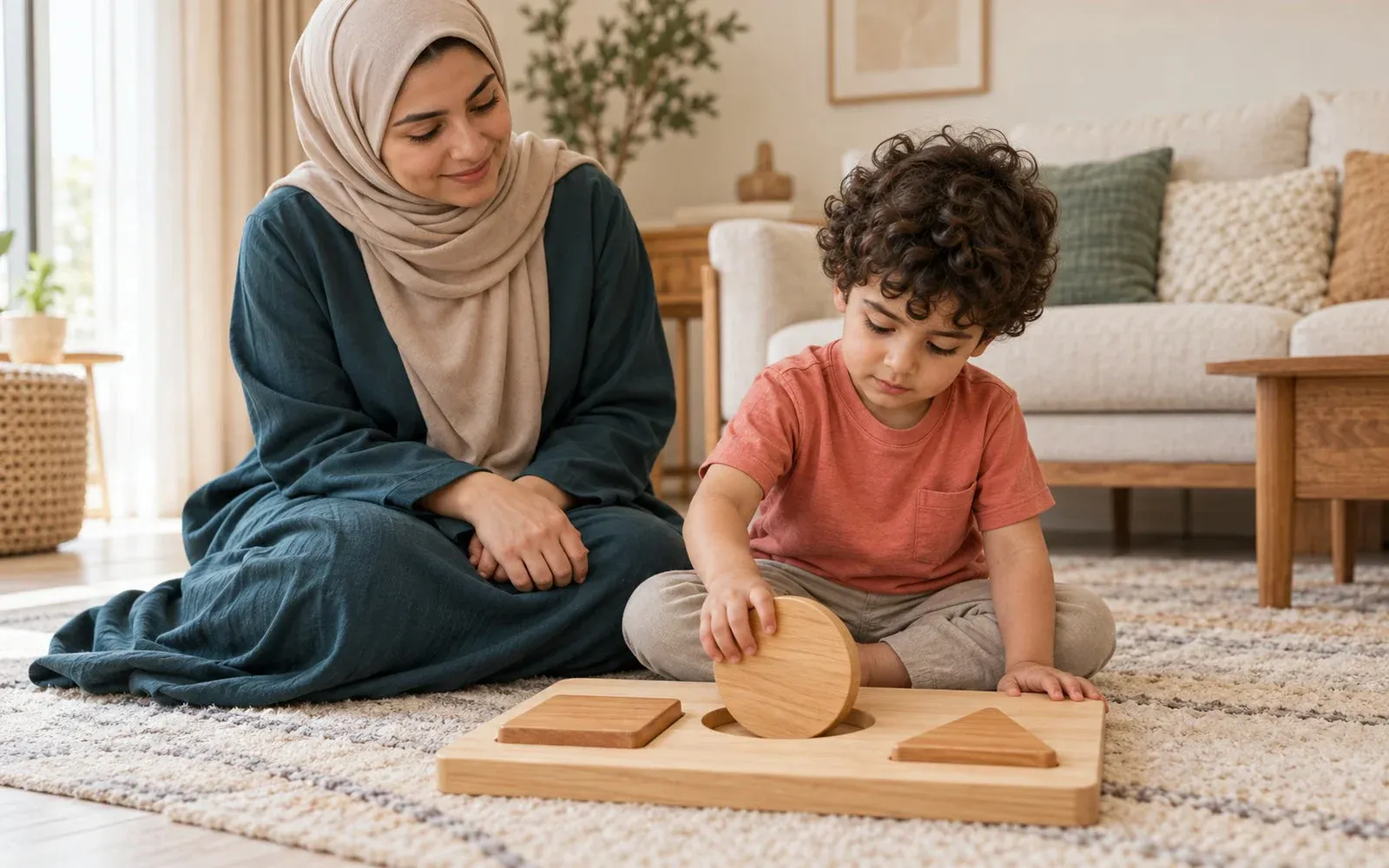
A very realistic toy tells the child what it represents, while a simple piece can change along with the story. A block might become:
-
Food for a doll.
-
A phone.
-
A little car.
-
A bed for a toy animal.
-
A package in a pretend store.
Large plastic containers, wide wooden spoons, short pieces of cloth, and sturdy cardboard boxes also work well for play, as long as they’re clean, safe, age-appropriate, and used with the necessary supervision.
Safety note: Don’t offer plastic bags, glass containers, long cords and strings, or small pieces that could be swallowed. Make sure boxes are stable and have no staples or sharp edges. For children under 3, always check age warnings and choking hazards before turning any household item into a play material.
5. Put Out a Few Props Instead of Setting Up a Whole Stage
Lots of props may seem encouraging, but they can get a child busy pulling things out and switching between them. Start with a small set, such as:
-
A doll + a piece of cloth + a big cup.
-
A truck + six big blocks.
-
Two toy animals + a box that stands for a house.
-
Two bowls + a big wooden spoon + three big pieces of pretend food.
If your child uses what’s in front of them, add one item that extends the story. And if they keep moving from one thing to the next, put out less. You can check the guide to helping a child who switches between toys quickly to set up a calmer space.
6. Comment on the Play Instead of Quizzing
A string of questions like “What’s this? What color? What are you cooking? Where’s the plate?” can turn the story into a test. Use short phrases connected to what the child is doing:
-
“The water’s hot… let’s wait a bit.”
-
“Teddy’s hungry.”
-
“The car needs gas.”
-
“You put the blanket on. It’s bedtime.”
You can add a word or two to what the child says. If they say “car,” you can say: “The car is going.” And if they say “Baby sleep,” you can respond: “Yes, the baby is sleeping in the bed.”
Don’t ask them to repeat the sentence, and don’t correct every word during play. The goal is to keep the interaction alive and give language meaning in the moment.
7. Add Just One Step to the Story
When your child repeats an action, you can extend the story by one small step:
-
Feeding the doll → offer her a cup.
-
Driving the car → place two blocks as a bridge.
-
Cooking in the bowl → give them a plate for serving.
-
Putting the animal in the box → add a piece of cloth as a blanket.
If they ignore what you added, don’t keep insisting on it. Their current idea may be enough, and the repetition itself is part of learning.
8. Accept That the Story Isn’t Completely Realistic
If your child says the block is an apple, we don’t correct them because it’s square. And if they have the animal drive the car from on top of it, we don’t need to move it to the right seat. The value of play here lies in the meaning the child created, not in matching reality.
We step in when an action is unsafe, or when the child needs real help, not when the story differs from what we imagined.
9. Repeat Scenes and Don’t Rush into a New Story
Your child may feed the doll the same way every day. That doesn’t mean their imagination has stalled. Repetition helps them consolidate the sequence and the words, and after a while they may add a blanket, a cup, or a new role.
Leave favorite props available for a reasonable amount of time. Don’t change the play theme every day in search of “more development,” and don’t measure a session’s success by how many roles the child acted out.
Does Pretend Play Require Special Toys?
No. It can start with safe things you already have at home, or with simple toys that allow more than one use. What matters isn’t how the set looks in a photo, but what the child can do with it.
Idea A few materials are enough How does the adult start? Feeding the doll A doll, a big cup, a piece that stands for food Offers one sip, then leaves the materials A car trip A big car, blocks for building a road Places two blocks as a bridge The animals’ house Two big animals, an open box, a piece of cloth Puts an animal in the house, then waits A simple store Two bowls, four big pieces, a cloth bag with short handles Asks for one piece and trades it for a big piece that stands for money A doctor’s visit A doll, a piece of cloth, a big, safe toy tool Listens to the doll’s heart with a single action Pretend cooking A stable plastic bowl, a wide wooden spoon, three big pieces Stirs once, then offers the bowl to the childBefore using any set, make sure the pieces are age-appropriate and that there are no small parts, batteries, or magnets within reach. Check the guide to choosing a safe toy for a child under 3.
How Do We Choose a Toy That Invites Pretending?
Look for a toy that:
-
Can be used in more than one way.
-
Doesn’t force the same single outcome every time.
-
Has big, safe pieces that suit the child’s age.
-
The child can move and arrange on their own.
-
Can be combined with blocks, animals, or simple containers.
-
Doesn’t rely on a button that plays out the whole story instead of the child.
-
Doesn’t require buying a new accessory for every idea.
Blocks, big animals, simple dolls, vehicles, play containers, and open-ended pieces can offer a variety of opportunities. But the word “Montessori” or “builds imagination” on a product page doesn’t prove that by itself; look at how the child actually uses the toy. The guide to Montessori toys beyond the marketing label can help you evaluate the design instead of relying on the name.
Common Mistakes That Shrink a Child’s Space in Play
Directing the story from beginning to end
When the adult decides the characters, the dialogue, and the outcome, the child becomes someone who just carries out instructions. Start with a small idea and leave them free to change it.
Buying a big set before any interest appears
Your child may not need a full kitchen; a bowl and a spoon may be enough. Test the idea with a few materials before buying a specialized set.
Correcting unrealistic use
A block can be a phone even if it doesn’t look like one. Correct what relates to safety, not the shape of their imagination.
Turning play into teaching questions
Learning colors and names can happen naturally, but a string of questions shifts the lead in play from the child to the adult.
Forcing a child to act out a role
If they don’t want to feed the doll or wear a hat, we don’t try to extract a response. Offer the idea and leave it available without pressure.
Comparing their story to a video or another child
One child may build a long story with words, while another shows their imagination through a short, silent action. Watch how your child develops over time instead of comparing how they perform.
When Is It Worth Talking to Your Pediatrician?
A child’s lack of interest in a particular pretend-play activity doesn’t mean there’s a problem, and the absence of one scene isn’t enough to judge their development. One child may prefer movement or building, and another may need time or a familiar example before pretending.
Talk to your pediatrician if you have broader concerns about your child’s way of playing, learning, speaking, or interacting, or if:
-
They’ve lost a skill they used to have.
-
They don’t imitate simple actions or gestures, along with other observations that concern you.
-
They don’t use objects in ways that fit their age, or don’t show interest in interacting in general.
-
There are repeated observations about language, responding to their name, or social communication.
-
You and their daycare or caregiver share the same concern.
The CDC recommends not waiting when there’s a concern or a lost skill, and instead discussing your observations with the doctor and asking for a developmental screening. Milestone checklists are for observation, not diagnosis.
How Do We Talk About Pretend Play at Giggly?
We won’t describe a product as something that:
-
Guarantees a more developed imagination.
-
Develops language automatically.
-
Raises intelligence.
-
Treats speech delay.
-
Teaches a child problem-solving on its own.
These are claims no single product can prove. Instead, we use observable descriptions:
-
The pieces can be used in more than one play scene.
-
It lets the child build, arrange, and give the pieces different meanings.
-
It makes it possible to act out everyday situations while parents join in.
-
It works without a screen or a ready-made electronic story.
-
It can be combined with blocks, animals, or big vehicles.
And before thinking about benefits, we check the age range, warnings, piece size, and material. Then you can browse the educational toys at Giggly and choose an activity that lets your child use their hands and lead a bigger part of the idea.
A Quick Checklist to Try Today
Try just one scene:
-
Choose a routine your child knows, like feeding a doll.
-
Put out only three big, safe items.
-
Show one action without a long explanation.
-
Hand the item back to your child and wait.
-
Describe what they’re doing instead of constantly asking questions.
-
Add one step if they seem interested.
-
Accept any safe use, even if it changes the story.
-
End the play when they’ve had enough, without asking them to finish the scene.
The Bottom Line
Pretend play often starts with a small, familiar action before it becomes stories and roles. A child might drink from an empty cup, then feed a doll, then use a block as if it were food, and over time link several steps together and include others in the story.
The best thing we can offer isn’t a whole stage set or a string of instructions. We need calm time, a few safe items, a short model, words connected to what the child is doing, and then room for them to change the meaning and repeat the idea in their own way.
Most importantly, pretend play is an opportunity, not a test. We keep an eye on the child’s overall development, ask the doctor’s opinion when concerns are broader or a skill is lost, and don’t turn differences between children into a daily comparison.
Frequently Asked Questions
When does pretend play start in children?
Simple beginnings may appear in the second half of the second year, like pretending to drink or feeding a doll, and then using one object in place of another and sequencing scenes develop over time. The ages are approximate, and play looks different from child to child.
Does drinking from an empty cup count as pretend play?
Yes, if the child is acting as if there’s a drink in it. This is a simple pretend action, and a child doesn’t need a whole story to start pretend play.
What’s the difference between pretend play and symbolic play?
The two terms are often used in similar ways. “Symbolic play” highlights the idea that one thing represents another, like a block that becomes a phone, while “pretend play” also includes acting out roles and events.
Does my child need a play kitchen or costumes?
No. A safe bowl, a big spoon, and a doll or some blocks may be enough. Simple, open-ended materials let a child change their meaning along with the story.
What should I do if my child doesn’t imitate the action?
Don’t repeat it like a test. Show one action, leave the materials available, and try the idea again another day. A child may watch before using the scene in their own way.
Should I step in when my child uses a toy incorrectly?
Step in if the use is unsafe or might break the toy and expose dangerous parts. But if it’s safe and gives the piece a new imaginary meaning, give them room.
Does repeating the same story mean a weak imagination?
No. Repeating a feeding or bedtime scene can help a child consolidate the sequence and the words. They may add a new step when they’re ready.
Does a lack of pretend play mean there’s a disorder?
No diagnosis can be made from a single behavior. If your concern comes with broader observations about language, communication, or play, or your child has lost a skill they had before, talk to your pediatrician and ask for a developmental screening.