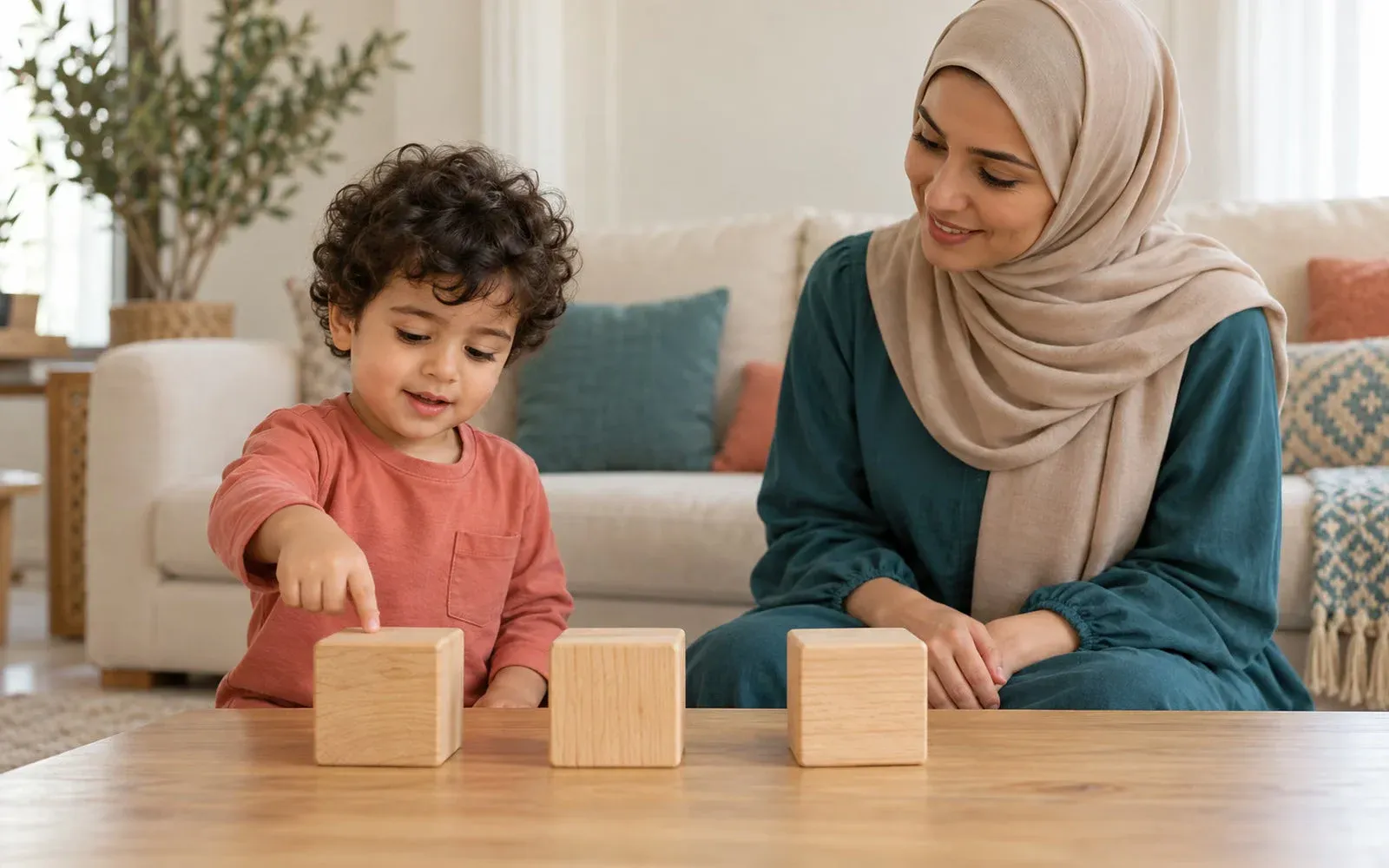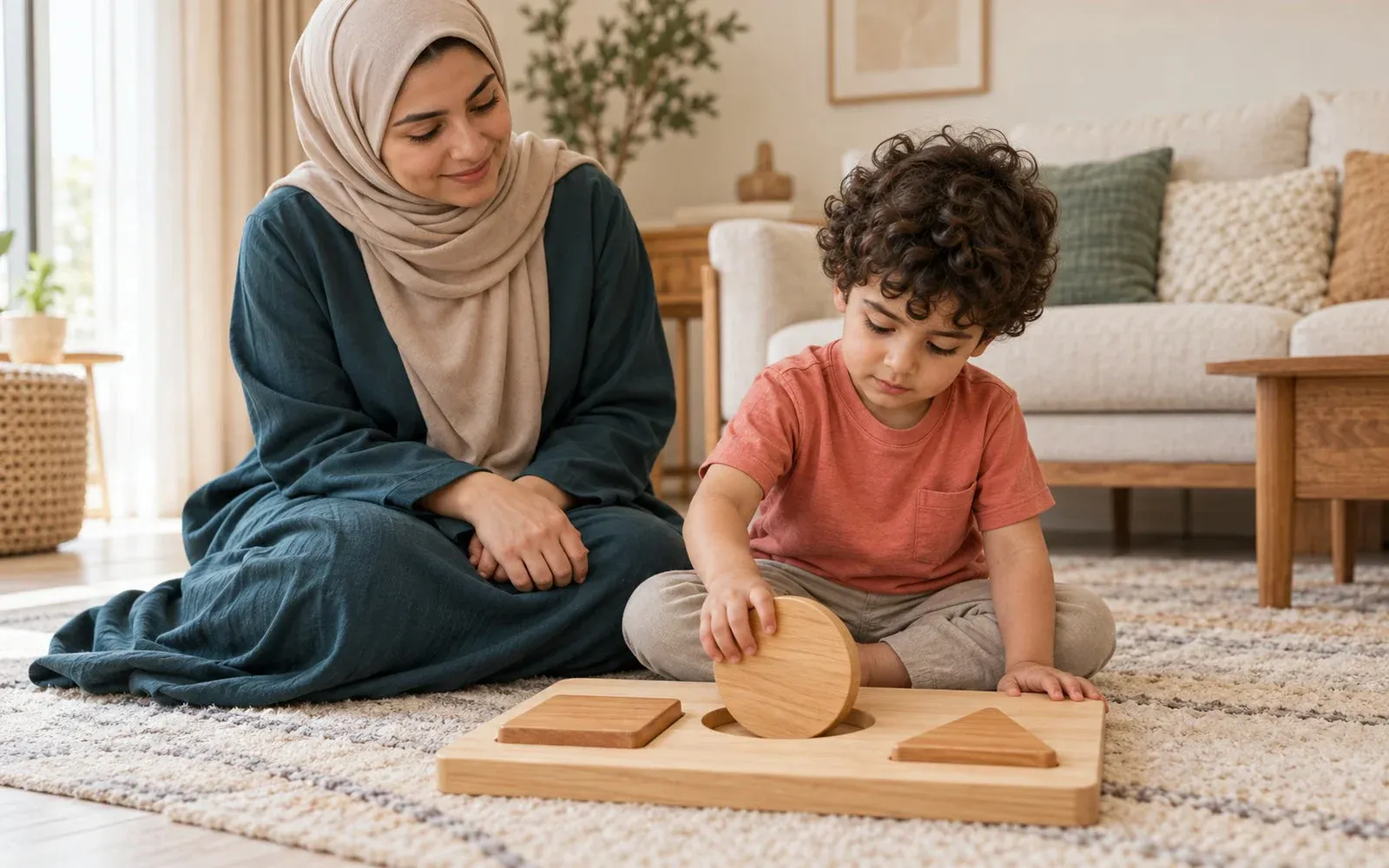
Why Does My Child Jump from Toy to Toy So Quickly? 8 Changes That Help Them Play More Calmly and for Longer
Does your child drop a toy after a few minutes and move on to another? Not every switch is a sign of distraction. Learn how too many choices, noise, and an activity’s difficulty affect play, and try 8 practical changes that support calmer play without pressure or buying more toys.
Why Does My Child Jump from Toy to Toy So Quickly? 8 Changes That Help Them Play More Calmly and for Longer
You put a new puzzle in front of your child, and they move a piece or two and then leave it. They move on to the blocks, and a minute later they go to the car, then open the toy drawer and start pulling everything out. That’s when the question comes up: Why won’t my child focus on one toy? Do they need a more exciting toy?
Usually, the answer isn’t buying a new toy. Young children are still learning to regulate their attention, and their play is affected by the number of choices, noise, hunger and tiredness, how difficult the activity is, and even the way we step in.
More importantly, moving between things doesn’t always mean a child is distracted. They might take a block to put in a truck, move the play food onto a plate, or leave the puzzle to look for a piece that resembles a picture in a book. Sometimes the child has expanded the play and connected two ideas, rather than losing interest.
In this guide, we’ll help you notice what’s actually happening, then try 8 simple changes to the environment and to the way a toy is offered. The goal isn’t to force your child to sit for a set amount of time, but to create conditions that give them a better chance to explore, repeat, and return to an activity on their own.
Important note: There is no single attention span that all children should reach at a certain age, and this article is not a developmental test or a way to diagnose an attention disorder. If you have ongoing concerns about how your child plays, communicates, or responds, or you notice they’ve lost a skill they had already gained, discuss it with your pediatrician or a specialist.
First: Is Your Child Really Switching, or Expanding the Play?
Before changing anything, watch what your child does after leaving the first toy.
Switching that may be a natural part of play
-
Taking a piece from one toy and using it in another activity in a meaningful way.
-
Coming back to the first toy after a few minutes and picking up where they left off.
-
Trying more than one way to use the same piece: building with it, then sorting it, then turning it into pretend food.
-
Moving between two related activities, like the car and the blocks to build a road.
-
Leaving an activity once they reach a clear result, then looking for a new challenge.
Among the milestones for age 2, the Centers for Disease Control and Prevention note that many children play with more than one toy at the same time, such as putting toy food on a plate. So we don’t ask a child to keep all their toys separate or to finish an entire activity the way we imagine it.
Switching that suggests the environment or the activity needs adjusting
-
Pulling toys out quickly without using any of them.
-
Constantly looking at a screen, a sound, or movement around them.
-
Asking for full help as soon as they see the activity.
-
Throwing the pieces or walking away at the same step every time.
-
Being unable to start playing because pieces are missing or mixed up across several toys.
-
Moving to a new toy every time an adult offers a question, a correction, or a suggestion.
These observations don’t diagnose a problem. They simply help us figure out the first change worth trying.
What Does Research Say About Having Too Many Toys?
In a study published in the journal Infant Behavior and Development, 36 toddlers played in two sessions: one with 4 toys available, and another with 16 toys. With fewer toys, the children played with each toy for longer stretches and used the toys in more varied ways.
This is a useful finding, but it’s important to understand its limits. The sample was small, and the sessions took place under specific research conditions, so the study doesn’t prove that four is the ideal number for every home, or that having many toys on its own causes attention problems. What it suggests in practical terms is that reducing the number of visible choices may be worth trying when a child spends their time switching and pulling things out instead of playing.
And the solution isn’t getting rid of toys. You can keep them out of sight and rotate them, so your child sees a number that suits the play space and their current interests.
1. Reduce the Visible Toys Instead of Buying a New One
Start with what you already have. Choose a small, varied selection instead of displaying all the toys at once, such as:
-
A fitting activity or puzzle.
-
A building or stacking toy.
-
An open-ended toy that allows more than one use.
-
A book or two.
-
A simple movement activity, if space allows.
There’s no magic number. You can start with four to six visible activities, then observe for a few days. If your child still seems unsure what to do, reduce further. And if they’re using everything in front of them in clear ways, there’s no need to cut the number just to follow a rule.
Put the other toys in a closed cabinet or in boxes your child doesn’t see all the time. This isn’t deprivation; every toy will come back at another time, like a fresh option.
2. Offer a Complete Activity with a Clear Starting Point
It may look like your child has lost interest, when the real problem is that the toy itself isn’t ready: a puzzle piece is missing, the blocks from two toys are mixed together, or the string is in one box and the pieces are in another.
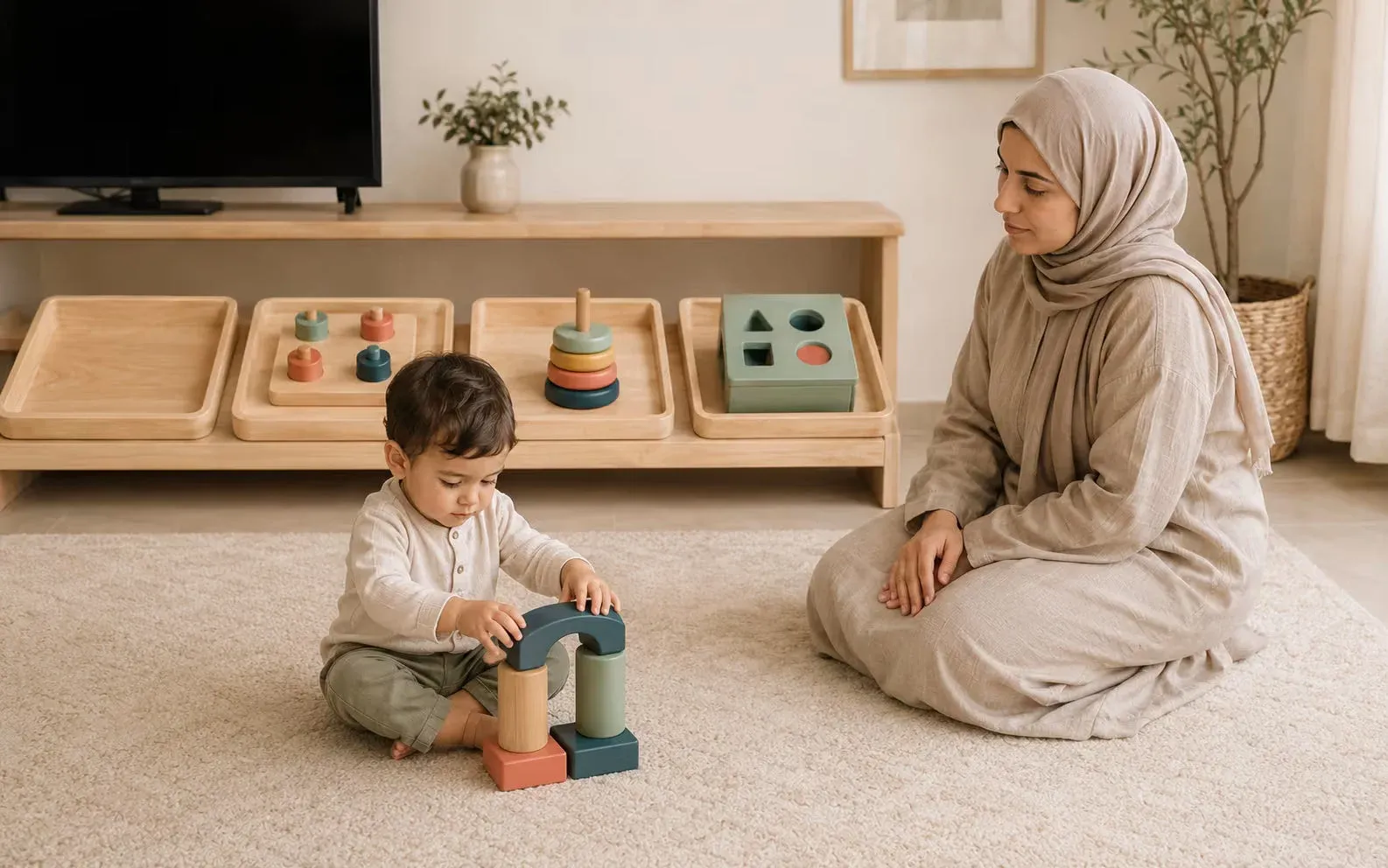
Gather each activity on its own tray or in its own basket:
-
All the pieces are there.
-
The number of pieces suits their current stage.
-
Your child has a clear place to start from and to return the toy to.
-
There are no other toys on top of or underneath the activity.
If the set is large, don’t put all of it out. You can offer two or three pieces of a sorting toy first, or six blocks instead of the whole box. Simplifying here doesn’t change the toy; it makes the first step visible and possible to try.
If you want to make sure an activity matches your child’s current abilities, see the guide to choosing the right educational toy by age.
3. Turn Off the TV in the Background
A child doesn’t need to sit in front of a screen for it to affect their play. In a study of 50 children aged 12, 24, and 36 months, having a TV program on in the background shortened play episodes and reduced focused attention, even though the children looked at the screen for only a few seconds at a time.
For calm playtime:
-
Turn the TV off instead of leaving it on with no one watching.
-
Keep the adult’s phone off the table or the floor.
-
Choose a corner without constant household traffic, if possible.
-
Reduce overlapping sounds; we don’t need a TV, music, and a noise-making toy all at the same time.
This doesn’t mean your home has to become silent. The goal is to remove the constant distraction that competes with the toy for your child’s attention.
4. Adjust the Level of Challenge: Not Too Easy, Not Frustrating
When a toy is too easy, a child may finish it right away and leave it. And when it’s much harder than they can manage, they may walk away because they can’t start the first step.
Watch for the signs:
It may be too easy when:
-
They do it the same way, quickly, every time.
-
They don’t need to look or experiment.
-
There’s no other way to use the pieces or increase the challenge.
It may be too hard when:
-
They don’t understand the goal after you show one action.
-
They can’t grasp or move the pieces at all.
-
They need the adult to do most of the steps.
-
They get upset at the same point in every attempt.
Before swapping the toy, change the level of the activity: reduce the pieces, stabilize the base, place a piece near its spot, or build a shorter model. And if your child masters the activity, add just one challenge instead of jumping to a complicated toy.
5. Show One Action, Then Step Back
Too much explanation can compete with the toy itself. Instead of a string of instructions and questions, slowly show one basic action: put on one ring, or fit in one piece, then hand the activity back to your child and wait.
ZERO TO THREE advises following the child’s lead and offering just enough help to prevent frustration, without doing the task for them every time. You can apply this with the following sequence:
-
Wait a little before stepping in.
-
Use a short comment, like “The piece is turning,” instead of a quiz question.
-
Show one step again if they need it.
-
Move the piece closer instead of fitting it in completely.
-
Pull your hands back and leave the attempt to them.
Sometimes a child leaves a toy because playtime has turned into a string of commands: “Where’s the red one? Put it here. No, turn it. Good job! Now the square.” When the adult steps back a little, the activity belongs to the child again.
6. Follow Their Interest and Add a Small Extension
If your child is stacking blocks and then starts pushing them around like cars, don’t immediately steer them back to “the right way.” Watch for the idea they’re trying to build and add just one small element:
-
Make a road out of two pieces.
-
Place one animal near the tower.
-
Suggest a container for carrying the pieces.
-
Name what they’re doing without taking control: “You made a long line.”
A toy that allows more than one way to play may hold a child’s interest because the activity changes from within, not because we swap the toy every minute. The American Academy of Pediatrics explains that simple things like blocks, boxes, wooden spoons, shape sorters, and puzzles let children ages 1 to 3 learn through curiosity and child-led play.
If you want to understand the difference between a clearly defined activity and open-ended play, also read the guide to Montessori toys beyond the marketing label.
7. Allow Movement Before Asking Them to Sit
Some children need to move before a table activity, and that doesn’t mean they can’t focus. You can try five or ten minutes of suitable, safe physical activity, such as:
-
Pushing or kicking a big ball.
-
Copying the movements to a short song.
-
Walking between two cushions placed safely on the floor.
-
Carrying big blocks from one basket to another.
Then offer a short activity at the table or on the rug. HealthyChildren guidance notes that some movement-seeking children may do better with table activities after a chance to move.
But don’t turn this into a fixed requirement or a mandatory “burning off energy.” Watch your child: they may be ready to sit in the morning and need to move at another time.
8. Build In a Predictable Playtime Instead of Measuring Your Child in Minutes
A routine helps a child know what’s coming: a snack, then calm playtime, then a simple tidy-up. We don’t need a timer that pressures them, or a condition like “Finish the puzzle before you get up.”
Start with a short, realistic amount of time, and sit near your child at first. The adult can join in with full attention for a few minutes, then simply say they’ll stay close while the child carries on. If your child comes back asking you to join in, respond without turning independent play into a pass-or-fail test.
Watch for signs of tiredness, hunger, or having had enough. When a child turns their face away, becomes easily upset, or loses control of the pieces, they may need a break, not a more exciting toy.
A Simple Way to Rotate Toys Without a Complicated Schedule
Rotating toys means keeping a small selection out and temporarily storing the rest, then swapping some of them based on how your child uses them. You don’t need to buy a special shelf or change the selection every week on a fixed day.
Try these steps:
-
Group toys by type of activity, not just by color or size.
-
Choose a varied selection that suits your child’s age and the shelf space.
-
Leave out the toy your child keeps coming back to; don’t take it away because it “has had its turn.”
-
Put away a toy they don’t go near after several calm opportunities.
-
Bring it back after a while, or offer it again with fewer pieces.
-
Swap one or two toys at a time, not the whole shelf.
-
Keep each activity, with all its pieces, in its own box or tray.
The goal of rotation isn’t to constantly surprise your child, but to reduce visual competition and keep activities clear and complete.
How Do We Know the Change Helped?
Don’t measure success by minutes alone. Look for changes in the quality of play:
-
Your child comes back to a toy after leaving it.
-
They try a second way instead of immediately asking for a new toy.
-
They repeat an action several times on their own.
-
They need less help from the adult.
-
They combine two toys in a meaningful way.
-
They put some pieces back on the tray when they’re done.
-
They show curiosity and effort, even if they don’t reach the end result.
One child may play with stacking rings for five minutes but experiment with ordering, flipping, and rolling. Another child may sit for longer while waiting for the adult to do everything. Duration alone doesn’t tell us which of the two experiences is richer.
Common Mistakes When a Child Leaves a Toy Quickly
Buying a new toy every time they seem bored
More choices may increase switching instead of solving the problem. First try putting out fewer toys and changing the way you offer one you already have.
Putting out all the pieces to show the toy’s “value”
The toy may have 20 pieces, but today your child needs only four. The value isn’t in seeing everything at once.
Correcting every attempt
Constant intervention makes a child look at the adult instead of the piece, and they may wait for directions instead of experimenting.
Comparing your child to a sibling or a video online
A short clip doesn’t show a child’s whole day, and children differ in their interests, their stage, and when they’re ready to play.
Forcing them to finish the toy
Play isn’t homework. You can invite them to tidy up the pieces, but we don’t tie the value of the experience to finishing the puzzle or building the tower the way we planned.
Swapping toys too quickly
A child may ignore a toy on the first day, then come back to it after seeing it again or watching a simple action. Give it more than one chance before rotating it out.
When Is It Worth Asking Your Pediatrician?
Switching between toys isn’t enough on its own to conclude there’s a problem. Talk to your pediatrician if you have broader concerns about your child’s way of playing, learning, speaking, or interacting, or if:
-
They’ve lost a skill they used to have.
-
They don’t respond to sounds or to their name in a way that concerns you.
-
They don’t seem interested in any activity or interaction, not just in one particular toy.
-
They have difficulty using their hands or body in the way expected for their age.
-
You have a recurring observation that you share with their caregiver or daycare.
The CDC recommends that parents not wait when they have a concern or when a child loses a skill they had already gained, but instead discuss their observations with the doctor and ask for a developmental screening if needed. Milestone checklists help with observation, but they are not a substitute for a validated developmental screening tool.
How Do We Talk About “Focus” at Giggly?
We won’t describe a toy as something that “treats distractibility,” “increases focus,” or “makes a child smarter.” These are bigger promises than any single product can prove.
A more accurate description is what the toy actually makes possible:
-
It gives a child the chance to repeat a specific action.
-
It allows sorting, building, or matching at more than one level.
-
A few of its pieces can be offered at first, with the challenge increased later.
-
It supports a calm activity without a screen or excessive effects.
-
It encourages independent effort when it matches the child’s abilities.
And before offering any toy, age-appropriateness and safety come first. Check the guide to choosing a safe toy for a child under 3, then browse the educational toys at Giggly and compare the age range, pieces, and way of playing for each product.
A Quick Checklist to Try Today
Instead of changing everything at once, try these today:
-
Turn off the TV in the background.
-
Keep only four to six clear activities within view.
-
Choose one toy with all its pieces that suits your child’s abilities.
-
Show one action, then wait.
-
Use a short comment instead of five questions.
-
Let your child combine two toys if their way of doing it is safe and meaningful.
-
Notice what they did, not just how many minutes they sat.
-
Write down one change that worked so you can repeat it tomorrow.
The Bottom Line
When a child moves quickly between toys, we don’t immediately assume they need a more exciting toy or that they have a focus problem. We start by observing: Are they connecting activities? Are there too many choices? Is the TV on? Is the toy too hard or missing pieces? And are we giving them room to try?
Putting out fewer toys, preparing a complete activity, removing the background screen, adjusting the challenge, and stepping in as little as possible may change the quality of play more than buying a new box of toys. And success doesn’t mean a child sitting quietly for half an hour; it means they explore, repeat, come back, and lead a bigger part of their play themselves.
Frequently Asked Questions
Do too many toys make a child distracted?
Too many visible choices can make play harder for some children. A small study found that children played longer and in more varied ways with 4 toys instead of 16, but it doesn’t prove an ideal number for everyone. Try putting out fewer toys and watch your child.
How many toys should I put out for my child?
There’s no fixed number. You can start with four to six varied, complete activities, then add or remove based on how your child uses them and the space available. What matters is that the shelf doesn’t get crowded and the pieces don’t get mixed up.
Should my child finish a toy before moving on to another?
No. You can invite them to tidy it up, but play isn’t a chore that has to be completed. A child may move on because they’ve finished their idea or want to use a piece in another activity.
When should I rotate toys?
Rotate a toy when your child no longer uses it after several opportunities, or when they’ve mastered it and no longer find it challenging. Leave a favorite toy out as long as they keep coming back to it; there’s no need for a strict weekly schedule.
Does independent play mean leaving my child alone?
No. It means your child leads the activity more, while the adult stays close and provides age-appropriate supervision. You can start with playing together, then step back a little while keeping safety and connection in place.
Does background TV have an effect even if my child isn’t watching it?
A study of young children found that background TV shortened play episodes and reduced focused attention, even with only brief glances at it. So it’s worth turning it off during calm play.
What should I do if the toy is too hard?
Reduce the number of pieces, stabilize the base, show one action, or move the piece closer to its spot. If your child still needs the adult to do every step, the activity may be ahead of their current abilities.
Does leaving toys quickly mean ADHD?
That can’t be concluded from a single behavior during play, and articles and toys don’t diagnose any disorder. If the concern is ongoing and shows up across different activities and settings, or comes with a lost skill or other observations about development and communication, talk to your pediatrician.
Trusted Sources Used in Preparing This Article
-
The effect of the number of toys in the environment on toddlers’ play — PubMed
-
The effects of background television on young children’s play — PubMed
-
Tips on playing with babies and toddlers and following the child’s lead — ZERO TO THREE
-
Independent play and reducing choices and screens — ZERO TO THREE
-
When play gets boring: fewer toys and calm involvement — ZERO TO THREE
-
The power of play for children ages 1 to 3 — HealthyChildren / American Academy of Pediatrics
-
Supporting skills and attention during play — HealthyChildren
-
Attention during shared play between infants and adults — PubMed
-
Developmental milestones at age 2 and when to talk to the doctor — CDC